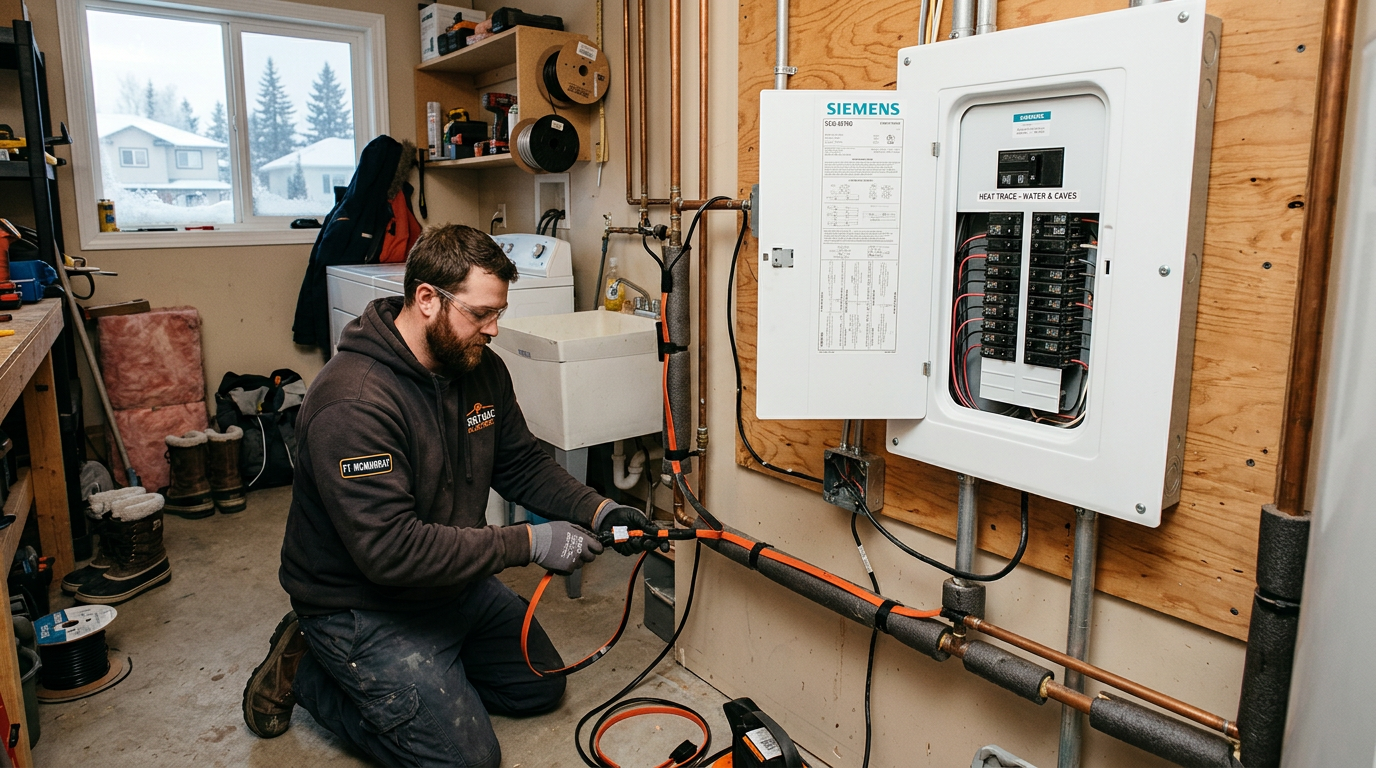
When winter arrives in the Wood Buffalo region, temperatures regularly plummet to -40°C and below. For homeowners in neighbourhoods like Timberlea, Thickwood, and Abasand, these extreme freeze cycles present severe challenges. Frozen water lines, thick ice dams on roof eaves, and hazardous sheets of ice on concrete driveways and ramps are not just inconveniences—they are costly emergencies waiting to happen. For the many oil-sands shift workers who travel to site for days or weeks at a time, leaving a home unattended during a cold snap makes reliable freeze protection absolutely critical.
As an experienced electrician, I have seen the devastating aftermath of burst pipes and collapsed gutters. Fortunately, modern, professionally installed heating systems offer an incredibly reliable line of defence. In this guide, we will dive deep into the differences between retail heat tapes and industrial-grade self-regulating heat trace systems, examine key Canadian Electrical Code rules, and explain how to design a safe, highly efficient freeze-protection system tailored to our northern Alberta climate.
Why do standard heat tapes fail in northern Alberta winters?
Many homeowners first encounter freeze protection by purchasing retail "heat tape Alberta" products from local big-box stores. These products are typically constant-wattage cables that supply a fixed amount of heat whenever they are plugged in. While cheap upfront, they are highly prone to premature failure and can even present serious safety hazards when subjected to the intense cold of our northern winters.
Constant-wattage heat tapes rely on a simple internal heating element. If the cable is wrapped too tightly, overlaps itself, or becomes insulated by debris, heat cannot dissipate. This leads to localized overheating, which can melt plastic water pipes or, in worst-case scenarios, ignite nearby building materials. If you are experiencing a situation where a safety device is consistently shutting down your system, you can learn more about diagnostics in our guide on why your breaker keeps tripping.
In contrast, commercial-grade heat trace Fort McMurray installations utilize self-regulating (or self-limiting) cable technology. These systems automatically adjust their heat output based on the surrounding ambient temperature at every single point along the run. When the temperature drops, the cable's core contracts, opening electrical paths and increasing heat output. As the temperature rises, the core expands, reducing electrical pathways and lowering energy consumption. This makes self-regulating cables incredibly energy-efficient and, crucially, safe to overlap without the risk of hot spots or melting.
How does self-regulating heat trace technology actually work?
To understand why self-regulating cable is the gold standard for freeze protection in Wood Buffalo, we need to look at its construction. The cable consists of two parallel copper bus wires embedded within a specially formulated semi-conductive polymer matrix. This matrix is the brain of the cable.
At a microscopic level, this polymer matrix contains countess carbon pathways. As the ambient temperature surrounding the pipe or roof drops, the polymer contracts. This contraction pulls the carbon particles closer together, creating thousands of microscopic electrical paths between the two bus wires. As electricity flows across these paths, it generates heat to protect the surface.
Conversely, if a section of the pipe becomes warm—perhaps because it passes through an insulated floor joist or receives direct sunlight—the polymer in that specific section expands. This expansion separates the carbon particles, disrupting the electrical paths and immediately lowering the heat output in that area. This localized, point-by-point adjustment ensures that the cable never wastes energy or overheats, even if it is running through varying temperature zones. This is particularly vital for homeowners trying to manage energy costs while ensuring robust winter electrical safety.
What electrical code requirements govern residential heat trace installation?
Because heating cables are often installed in wet, outdoor, or hard-to-reach locations, they are subject to strict regulations under the Canadian Electrical Code (CEC) and the Alberta Safety Codes Act. Ensuring your system complies with these codes is not just a legal requirement; it is a critical safety measure to prevent fires and electrical shocks.
1. Approved Equipment and Markings
Under Rule 2-024, all electrical equipment installed in Alberta must bear an approved certification mark from an accredited testing laboratory (such as CSA or ULc). Cheap, unapproved heating cables imported online without these certifications are illegal to install and can void your home insurance coverage in the event of a fire.
2. Ground Fault Protection
Standard household circuits rely on traditional overcurrent protection. However, because heating cables operate in damp environments, they require specialized ground fault protection. According to the Canadian Electrical Code, heating cable circuits must be protected by Ground Fault Circuit Interrupter (GFCI) or Ground Fault Equipment Protection (GFEP) devices. This matches the spirit of safety outlined in Rule 26-700 / 26-722 / 26-724, which mandates protective ground-fault devices in damp, outdoor, or wet environments to prevent shock hazards.
3. Continuous Load Sizing
Heating systems are classified as continuous loads because they can operate for hours on end during cold snaps. Under Rule 8-104, the continuous load on a circuit must not exceed 80% of the rating of the overcurrent device protecting that circuit, unless the assembly is specifically rated for 100% continuous operation. For example, on a standard 15-amp breaker, the maximum continuous load allowed is 12 amps. Properly calculating these loads prevents hazardous thermal stress on your electrical panel.
4. Overcurrent Protection and Sizing
Calculating the inrush current is one of the most overlooked aspects of heat trace design. When self-regulating cable is energized at sub-zero temperatures, it has very low resistance, drawing a massive spike of startup current (inrush) for several seconds. Under Rule 14-104, the overcurrent device rating must be carefully calculated to accommodate this temporary inrush current without nuisance tripping, while still providing robust protection against sustained overloads. If you suspect your panel cannot handle these loads, you should consider reviewing your home's electrical capacity; check our resource on electrical panel upgrade services to see if your system needs a modern boost.
5. Bonding and Grounding
To ensure any fault current is safely directed to ground rather than through your piping or gutters, commercial-grade heat trace features a tinned copper grounding braid. Under the Rule 10-700 series, this braid must be securely bonded to the building's electrical grounding system. This provides a low-resistance path to trip the breaker immediately if the cable is ever physically damaged by shifting ice or wildlife.
Can you install heat trace on plastic PEX water lines?
Yes, but doing so requires specialized techniques. Standard cross-linked polyethylene (PEX) plumbing is highly popular in modern homes across Eagle Ridge and Parsons Creek, but plastic does not conduct heat nearly as well as copper or copper-alloy pipes. If you simply run a heat trace cable along a plastic pipe, much of the heat will escape into the surrounding air rather than warming the water inside.
To overcome this poor thermal conductivity, we use a specific installation method:
- Aluminum Foil Tape: We first apply a layer of heavy-duty aluminum foil tape along the entire path of the pipe. The self-regulating heat trace cable is then secured directly on top of this foil. A second layer of aluminum foil tape is wrapped over the cable. This creates a highly conductive metallic path that distributes the heat evenly around the circumference of the PEX pipe, preventing localized hot spots.
- Accurate Thermostat Controls: PEX has a maximum temperature rating. While self-regulating cables are safe, we install dedicated sensing thermostats to ensure the pipe temperature remains in a safe window (typically between 4°C and 10°C), preventing the plastic from weakening over time.
- Proper Insulation: Once the cable and foil are secured, the entire assembly must be wrapped in high-quality closed-cell foam insulation. This ensures the heat is directed inward toward the pipe rather than lost to the freezing crawlspace or joist cavity.
If your heating cable setup is improperly installed or overloaded, it can lead to tripped breakers, leaving your pipes vulnerable. Read more about protecting your home's power distribution in our article on preventing overloaded circuits.
How should you design heat trace for eaves and gutters?
Ice dams are a major structural threat in Wood Buffalo. When heat escapes from your attic, it melts the snow on your roof. This water runs down to the cold eaves and gutters, where it instantly refreezes, forming a thick dam of ice. Over time, water backs up under your shingles, rotting your roof deck and leaking into your ceilings and walls. This is incredibly common in older, mature areas like Thickwood and Beacon Hill.
An engineered roof and gutter heat trace system prevents this by creating a clear path for meltwater to drain safely to the ground. A typical installation involves:
- A Zig-Zag pattern (Snake Pattern): The cable is secured in a series of continuous loops along the roof edge, extending up past the wall line (usually 12 to 24 inches depending on the overhang). This creates melted channels so water can run off the roof rather than pooling.
- Gutter and Downspout Runs: The cable must run down into the gutters and all the way through the downspouts, extending below the frost line or to a safe discharge point. If you only heat the roof, the water will simply freeze and split your downspouts.
- Robust Controls: Running roof heat trace manually is highly inefficient. We install ambient-temperature and moisture sensors. The system will only energize when both conditions are met: the temperature is below freezing and moisture (snow or ice) is present. This saves thousands of kilowatt-hours over our long winters.
For high-capacity installations, such as heated concrete ramps or extensive gutter systems, your utility service must be evaluated. We recommend checking our detailed electrical panel upgrade guide to understand how your residential service can safely support these high-draw winter systems.
Comparison of Heat Trace Systems
FeatureRetail Heat Tape (Constant Wattage)Self-Regulating Heat TraceSafetyHigh risk of overheating if overlapped. Fire hazard on dry materials.Incredibly safe; automatically limits maximum temperature. Safe to overlap.Energy EfficiencyPoor. Draws 100% power constantly unless manually unplugged.Excellent. Heat output drops locally in response to warmer areas.DurabilityTypically lasts 1 to 3 seasons. Prone to internal burnouts.Industrial grade. Often lasts 10 to 20+ years when properly installed.CustomizationFixed lengths only. Cannot be cut to fit in the field.Cut-to-length on-site, allowing for perfect custom layouts.Disclaimer: Always pull the required permit and hire a licensed electrician. This work falls under the Alberta Safety Codes Act.
About the Author
Mohammad is an Alberta Master Electrician (License #8368) and Red Seal certified professional with over 12 years of hands-on electrical experience serving the Wood Buffalo region. Specializing in northern climate wiring, cold-weather freeze protection, and industrial-grade residential upgrades, Mohammad and his team at Crescent Electric provide fully licensed, permitted, and insured electrical services designed to withstand the harshest Fort McMurray winters.
RELATED TOPICS:
