If you own a home in Thickwood, Timberlea, or Beacon Hill built between the mid-1960s and late-1970s, there is a high probability you have aluminum wiring behind your walls.
For decades, this wiring sat silently. But recently, many Fort McMurray homeowners are receiving scary letters from their insurance providers demanding an "Electrical Safety Inspection" or threatening to cancel coverage.
Why the sudden panic? And more importantly—do you really need to spend $20,000 to rewire your entire house?
The answer is usually no. Here is the truth about aluminum wiring and the safe, insurance-approved way we fix it.
## Why is Aluminum Wiring Dangerous?
Aluminum isn't inherently "evil," but it behaves differently than the copper wiring used today.
1. The "Cold Flow" Problem: Aluminum is a softer metal than copper. When it heats up (like when you run a hair dryer) it expands. When it cools, it contracts. Over thousands of cycles, the wire actually "wiggles" loose from under the screws on your outlets and switches.
2. Oxidation: When exposed to air, aluminum forms a layer of oxidation that resists electricity. This resistance creates heat—lots of it.
3. The Result: A loose, oxidized connection can begin to arc (spark) inside your wall, melting the outlet or starting a fire.
## The "Purple Marrette" Myth
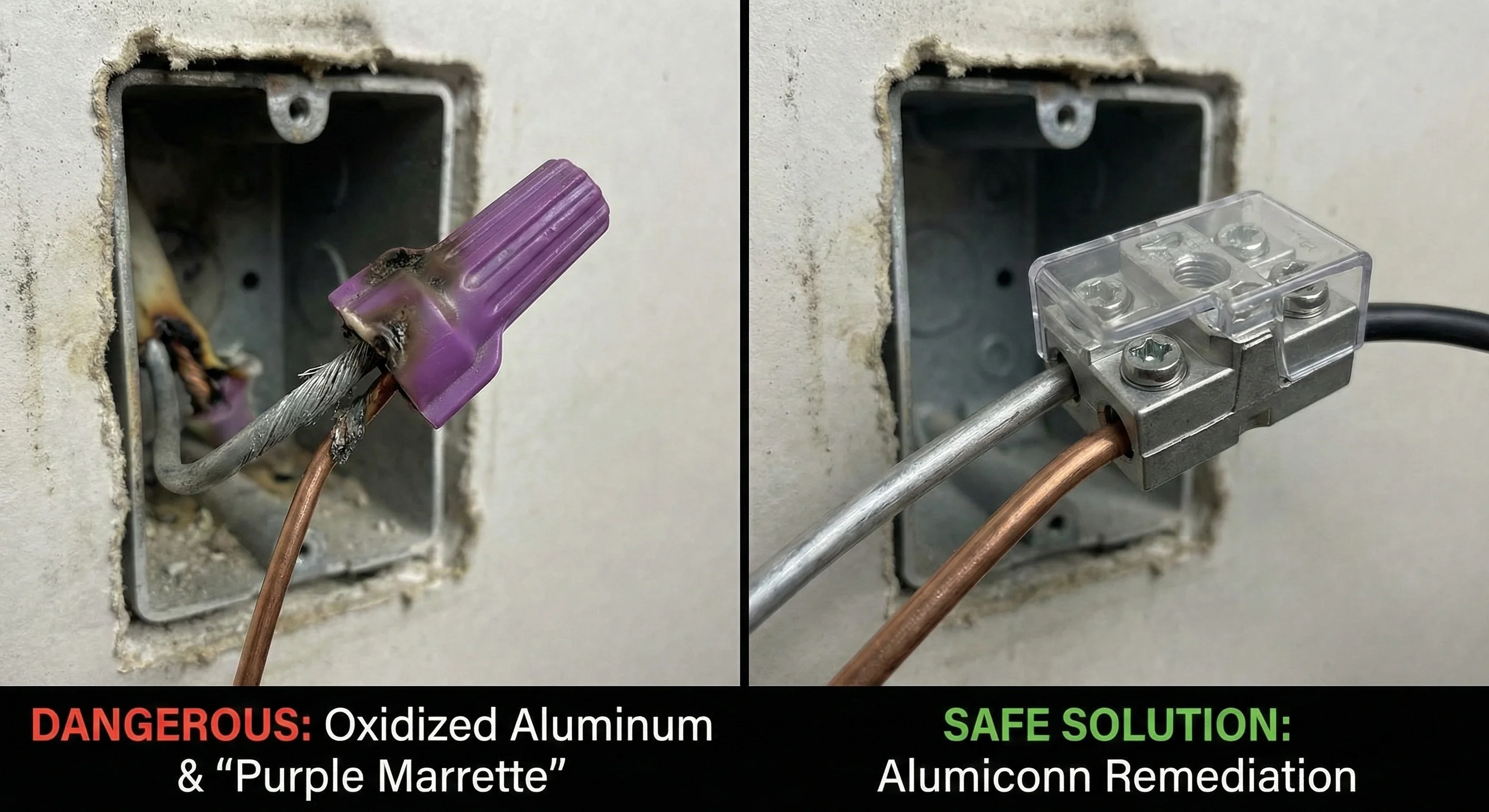
For years, the cheap fix was to twist the aluminum wire together with a new copper wire using a generic "purple wire nut" (marrette).
We rarely recommend this.
While technically allowed in some cases, these simple twist-on connectors often fail because they don't physically separate the two metals, leading to galvanic corrosion (where the copper eats the aluminum).
## The Crescent Solution: Alumiconn Lugs
At Crescent Electric, we use the Alumiconn system—the gold standard for remediation in Alberta.
Unlike a simple wire nut, an Alumiconn connector is a tiny terminal block. It has separate ports for the aluminum and copper wires, meaning they never touch each other.
- Secure: A set screw clamps the wire down so it can't wiggle loose.
- Safe: It creates a permanent, code-compliant repair that insurers love.
- Affordable: It costs a fraction of the price of a full home rewire.
## Will My Insurance Accept This?
Yes. In 99% of cases, insurers like Intact, Aviva, and Wawanesa do not require you to tear down your drywall and replace every wire. They simply require a "Certificate of Inspection" from a Master Electrician confirming that the connections have been remediated.
Our Process:
1. We open every switch, outlet, and light fixture in your home.
2. We inspect the wires for heat damage (scorching).
3. We install Alumiconn connectors and new copper-rated devices.
4. We issue you the Master Electrician's Compliance Letter to send to your broker.
## Need a Full Rewire Instead?
In some cases—such as extensive heat damage, knob-and-tube wiring, or major renovations—a complete home rewire is the better long-term solution. Visit our Home Rewire Services page to learn about our 5-day rewire process that minimizes wall damage.
## Don't Wait for the Smell of Smoke
If you have noticed flickering lights, warm switch plates, or a "fishy" smell near outlets, your aluminum connections may already be failing.
Live in a 1970s home? Don't gamble with fire safety.
Book Your Aluminum Safety Inspection Today or call us at 587-557-5494.
## The Insurance Reality for Aluminum Wiring in Alberta
Most insurance providers operating in Alberta — including those serving Fort McMurray and the Regional Municipality of Wood Buffalo — now require a certified electrical inspection before they will issue or renew a homeowner''s policy on a property containing aluminum branch-circuit wiring. In many cases, full remediation (pigtailing every device with approved connectors, or a complete rewire) is mandatory before coverage is bound.
After our crews complete the remediation, Crescent Electric provides a signed Letter of Compliance referencing the Canadian Electrical Code (CEC) and the specific connectors used. This letter is what your insurance broker needs to clear the underwriting hold and keep your premiums from spiking. Without it, you may be quoted a "high-risk" rate or denied coverage outright — a serious problem when mortgage lenders require continuous insurance.
If you are buying or selling a 1960s–1970s home in Fort McMurray, request an aluminum-wiring inspection during the condition period. Discovering the issue after possession can cost the new owner thousands and delay move-in.
## The Beacon Hill and Thickwood Legacy
A large share of homes built in Fort McMurray during the aluminum-wiring boom (roughly 1965–1977) sit in Beacon Hill, the older sections of Thickwood Heights, and parts of Abasand. Aluminum is an excellent conductor by weight, but it has two properties that cause problems at terminations: a much higher coefficient of thermal expansion than copper, and a tough oxide layer that forms instantly when exposed to air.
Every time the circuit heats up under load and cools down again, the aluminum conductor expands and contracts more than the brass screw holding it. Over years — and especially in homes that swing from +30°C summers to -40°C winters — this "cold flow" loosens the connection. A loose connection arcs. An arc inside a wall cavity packed with insulation is exactly how electrical fires start.
Outlets, switches, and light fixtures are the highest-risk points. Junction boxes inside attics over Beacon Hill bungalows are a frequent failure spot we find during inspections.
## Alumiconn vs. Marrette 65: Why Connector Choice Matters
A common DIY repair is to twist aluminum and copper together inside a purple "Marrette 65" wire nut packed with anti-oxidant paste. While this product is CSA-listed, field experience and CPSC studies have shown failure rates that concern most professional electricians.
Crescent Electric uses AlumiConn connectors instead. AlumiConn is a small purple lug-style connector with three set-screws, each tightened to a specified torque. It creates a true mechanical lug termination between aluminum and copper — the same principle used in commercial panelboards. There is no twisting, no reliance on spring tension, and no possibility of one strand backing out under thermal cycling.
Every AlumiConn termination on our remediation jobs is torqued with a calibrated screwdriver and recorded. Combined with a copper pigtail to the device, this is the only pigtail method currently endorsed by both Health Canada and the U.S. CPSC for permanent aluminum-to-copper transitions.
## Local Expert Tip: Fort McMurray Aluminum Wiring
> Local Expert Tip — Beacon Hill & Thickwood Homes: If your house was built between 1965 and 1977 and you have never had the wiring inspected, book an aluminum-wiring assessment before your next insurance renewal. We see the highest concentration of unrepaired aluminum branch circuits in the original Beacon Hill bungalows and the lower streets of Thickwood. Our extreme temperature swings accelerate connector failure compared to milder climates, so what passed inspection 15 years ago may now be a fire risk.
## What a Full Remediation Visit Looks Like
A typical Crescent Electric aluminum remediation on a 1,200 sq ft Fort McMurray bungalow includes: opening every device box, cutting back any damaged conductor, installing an AlumiConn-and-copper pigtail at every receptacle, switch, and fixture, replacing any back-stabbed devices with side-wired spec-grade replacements, torquing every panel lug, and issuing the insurance compliance letter. Most homes are completed in one to two days with power restored each evening.
