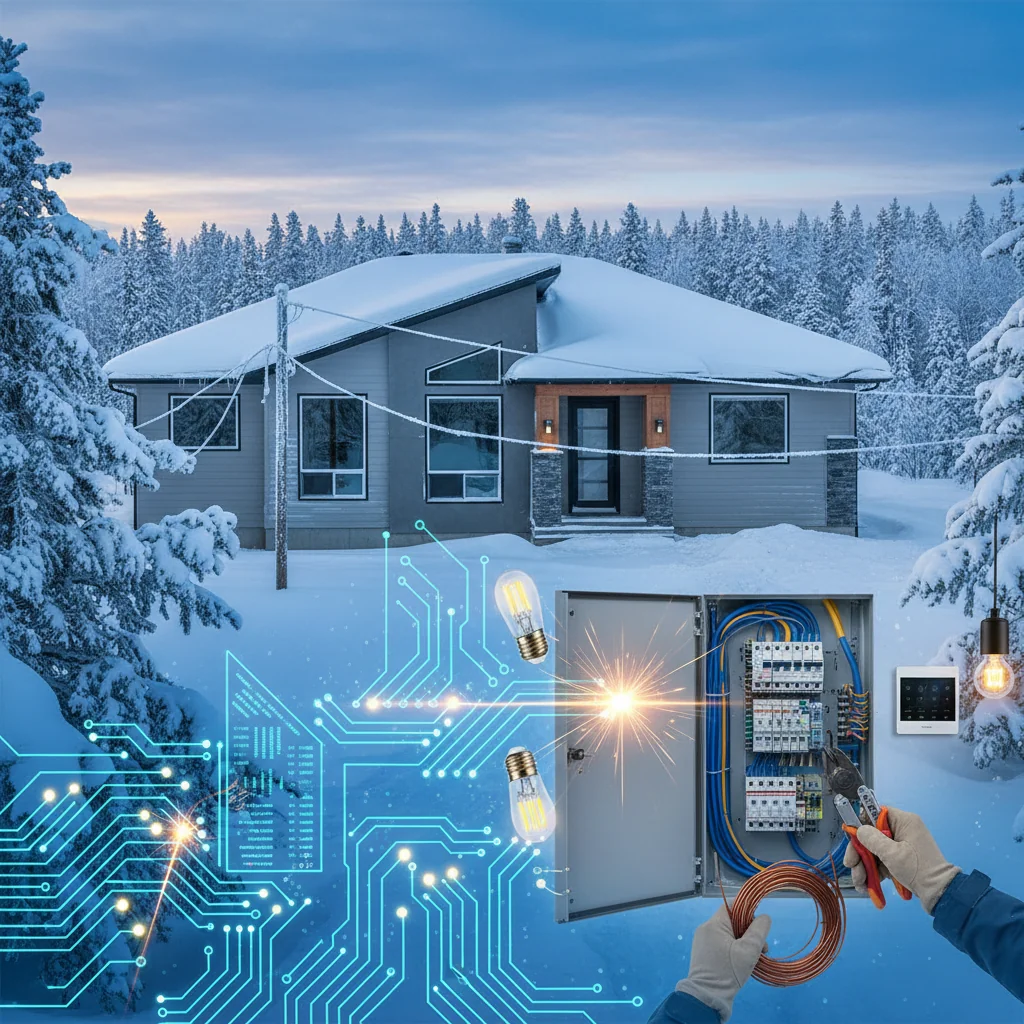
Fort McMurray residents face high electricity bills, especially during long, dark winters. These energy efficiency strategies can significantly reduce your costs while maintaining comfort.
LED Lighting Upgrades
The fastest ROI for energy efficiency:
- Energy Savings: LEDs use 75% less energy than incandescent bulbs
- Longevity: Last 25 times longer than traditional bulbs
- Better Light Quality: More natural light during dark winters
- Heat Reduction: Less wasted energy as heat (though this matters less in winter)
Upgrade Priority Areas:
1. High-use areas (kitchens, living rooms) 2. Outdoor lights (on for extended periods in winter) 3. Recessed lighting (often multiple bulbs) 4. Holiday lighting (massive savings over season)
Cost: Professional LED retrofit typically pays for itself in 2-3 years through energy savings.
Smart Thermostats and Zone Heating
Heating is your biggest electrical expense in Fort McMurray:
- Smart Learning: Thermostats learn your schedule and adjust automatically
- Remote Control: Adjust temperature from anywhere
- Energy Reports: Track usage and identify savings opportunities
- Zoned Heating: Heat only occupied rooms
Installation Tip: Requires compatible HVAC system and C-wire (common wire). Professional installation ensures proper setup and calibration.
Electrical Panel Optimization
An upgraded panel improves efficiency:
- Modern breakers reduce energy loss
- Proper load balancing prevents wasted power
- Identifies phantom loads and inefficient circuits
- Enables monitoring systems to track usage
Window Coverings and Insulation
Electrical upgrades work better with proper insulation:
- Seal electrical outlet boxes on exterior walls
- Insulate around recessed lights (use IC-rated fixtures)
- Weather-strip around electrical panel if on exterior wall
- Consider heated vapor barrier behind outlets
Peak Usage Management
Alberta's electricity rates vary by time of use:
- Run major appliances during off-peak hours
- Install timers on water heaters
- Program pool pumps and hot tub heaters strategically
- Consider load-sharing switches for high-draw appliances
Block Heater Timers
Essential for Fort McMurray vehicle owners:
- Block heaters only need 2-4 hours before starting
- Running 8+ hours wastes significant electricity
- Smart timers with temperature sensors optimize runtime
- Can save $200-400 per winter per vehicle
Appliance Upgrades
When replacing appliances, consider:
- ENERGY STAR certified models
- Right-sizing (don't overbuy capacity)
- Induction cooktops (more efficient than electric coil)
- Heat pump dryers (use 50% less energy)
Phantom Load Elimination
Many devices draw power when "off":
- Use smart power bars that fully cut power
- Unplug rarely-used appliances
- Install occupancy sensors in low-traffic areas
- Consider whole-home energy monitoring systems
Professional Energy Audits
A professional assessment identifies:
- Specific circuits drawing excess power
- Inefficient fixtures and appliances
- Potential for solar or alternative energy
- Prioritized upgrade recommendations with ROI calculations
Solar Considerations for Fort McMurray
While winter sun is limited, solar can work:
- Summer production can offset winter consumption
- Net metering programs provide credits
- Battery storage systems increase viability
- South-facing roofs without shade are essential
Professional electrical modifications needed for solar:
- Service upgrade (possibly to 200A+)
- Dedicated solar breaker in panel
- Proper grounding and disconnects
- Monitoring system installation
Quick Wins: Easy Efficiency Improvements
Start with these simple changes:
1. Replace most-used light bulbs with LEDs (DIY) 2. Install programmable power bars (DIY) 3. Add block heater timers (professional recommended) 4. Upgrade to ENERGY STAR appliances when replacing 5. Seal outlet and switch gaps with foam gaskets (DIY)
Long-Term Investments
Higher upfront cost, but significant long-term savings:
1. Electrical panel upgrade with monitoring 2. Whole-home LED conversion 3. Smart thermostat and HVAC upgrades 4. Energy-efficient appliance package 5. Solar pre-wiring or full installation
For a personalized energy efficiency assessment and professional electrical upgrades in Fort McMurray, contact Fort McMurray Electrician at (780) 607-1880.
## Combating "Phantom Loads" in Fort McMurray Homes
The average Wood Buffalo household bleeds 750–1,200 kWh per year to "vampire power" — devices drawing current while ostensibly off. At ATCO's 2026 regulated rate of roughly $0.158/kWh plus distribution and transmission riders, that's $180–$280 disappearing annually before you turn on a single light.
Worst offenders we measure during energy audits in Thickwood and Timberlea:
- Cable/PVR boxes: 25–35 W continuous (~260 kWh/yr each).
- Gaming consoles in "instant-on" mode: 12–18 W (PS5/Xbox Series X).
- Older plasma TVs and AVR receivers: 8–22 W standby.
- Garage door openers with Wi-Fi: 4–6 W.
- Phone/laptop chargers left plugged in: 0.5–2 W each (adds up across 12+ chargers per household).
We deploy two layers of defense:
- Smart power strips (TrickleStar, APC P11VT3) that cut power to peripherals when the master device sleeps.
- Whole-home energy monitoring with Sense, Emporia Vue 3, or Span panels — these clamp onto your service mains and use machine learning to identify each appliance's signature, then push a real-time dashboard to your phone.
> Local Expert Tip — Eagle Ridge: Homeowners with Span smart panels report 14–22% reductions in their first full year, mostly by spotting always-on loads they didn't know existed (heated towel racks, garage beer fridges, basement dehumidifiers).
Heat Loss Through Electrical Boxes at -40°C
Building science research from NRCan shows that uninsulated outlet and switch boxes on exterior walls account for 2–4% of total envelope heat loss in cold-climate homes. In a Fort McMurray winter where outside air hits -42°C and dew point swings 60°C across the wall assembly, every penetration matters.
The fix is fast and inexpensive:
- Foam outlet/switch gaskets (Diversitech, Frost King) installed behind the cover plate — $0.40 per device.
- Vapor barrier boots (Lessco air-tight boxes or site-built poly boots) sealed to the 6 mil polyethylene with acoustical sealant — required by the Alberta Building Code Section 9.25.3 for any exterior-wall device on a new build.
- Spray-foam back-fill behind the box cavity (using fire-rated low-expansion foam such as Hilti CP 620) for retrofits where the wall is open.
Combined, these measures typically eliminate the cold-air infiltration that forces baseboard heaters in Beacon Hill and Waterways bungalows to cycle 30–40% more often during a January cold snap.
> Local Expert Tip — Abasand: If your exterior outlets feel cold to the touch in January, you have measurable air leakage. We can pressure-test (blower-door) and seal an entire main floor in one day for under $600.
The Albedo Effect and Lighting Automation
Fresh snow reflects 80–90% of incident sunlight (albedo 0.8–0.9) versus 10–20% for bare ground. From late October through April, Wood Buffalo effectively gets a "second sun" bouncing off rooftops and yards. We use this to slash exterior lighting energy:
- Astronomical timers (Intermatic ET90215CR, Lutron Athena) that calculate true sunrise/sunset for latitude 56.73° N and adjust daily — no manual reset for daylight saving or solstice swings.
- Photocell + motion combos (RAB Lightcloud, Wattstopper) on garage and pathway fixtures so they only fire when actually dark and someone is present.
- Tunable-white LED drivers (DALI-2 or 0–10V) that dim to 10% during full-moon snow nights, where ambient reflected light is enough for safe walking.
Daylight in Fort McMurray swings from 6 hours 14 minutes on December 21st to 18 hours 19 minutes on June 21st — a 12-hour annual delta that no static timer can handle. Astronomical control alone typically cuts exterior lighting kWh by 35–55% versus dusk-to-dawn photocells.
> Local Expert Tip — Saprae Creek: Acreage owners with long driveways benefit most. We've installed astronomical-timer + LED retrofits that paid back in under 18 months on power bills alone.
Frequently Asked Questions
How much can a Fort McMurray homeowner realistically save per year?
A typical 2,200 sq ft home implementing all three measures (vampire-load control, sealed outlet boxes, astronomical lighting) saves $420–$780 annually based on current ATCO rates and our 2025 client data.
Do energy monitors like Sense or Emporia work with bi-directional solar?
Yes — Emporia Vue 3 and Span panels both support net-metered solar and EV charging on the same dashboard, making them ideal for Alberta Micro-Generation Regulation participants.
Are foam gaskets enough, or do I need full air-sealing?
For permitted renovations or new builds, the Alberta Building Code requires a continuous air barrier (vapor boots + sealed poly). Foam gaskets are a worthwhile retrofit for older homes but are not a code-compliant substitute on new construction.
