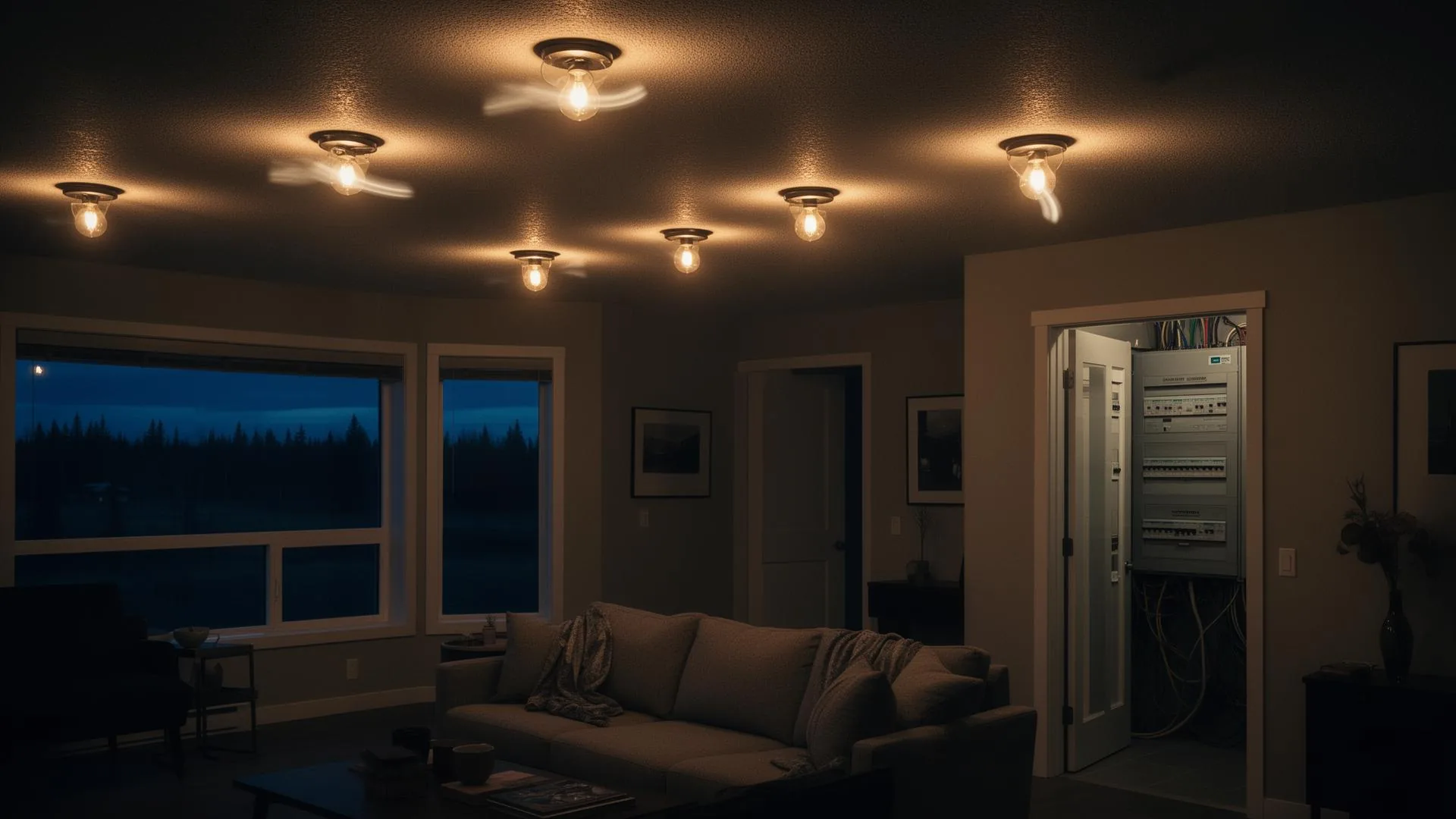
A single bulb that flickers is usually nothing — a loose bulb or a dying LED driver. But when every light in the house dims or flickers at the same time, that's a different conversation. It's one of the clearest warning signs of a serious electrical fault, and in Fort McMurray we treat it as urgent.
Here's what an Alberta Master Electrician looks for, in order of severity.
1. Loose Neutral at the Main Panel — The Dangerous One
If lights flicker house-wide, briefly brighten when one circuit kicks on, or dim when the furnace fan starts, the main neutral connection in your panel may be loose or corroded. This causes voltage on individual circuits to swing wildly — sometimes high enough to kill TVs, computers, and LED bulbs in a single afternoon.
This is not a wait-and-see problem. Call a 24/7 emergency electrician the same day. A failing neutral is a known fire ignition source.
2. Utility-Side Issue — ATCO's Service Drop
If your neighbours are seeing the same flicker, the problem is upstream of your panel. The service drop from the pole to your weatherhead, or the transformer feeding your block, may have a bad connection. Report it to ATCO Electric (310-5070) and they will dispatch a lineman.
3. Large Appliance Starting Up
A momentary dim when the furnace, central AC, well pump, or hot tub kicks on is normal — those motors briefly pull 3–5x their running current. If the dim is severe (lights drop noticeably for more than a second), the appliance probably needs its own dedicated circuit, or your panel doesn't have headroom and needs an upgrade to 200 amps.
4. Outdated Aluminum Wiring
Many Fort McMurray homes built between 1965 and 1975 were wired with aluminum branch circuits. Aluminum expands and contracts more than copper, loosening connections at outlets, switches, and breakers over time. A flicker tied to a specific room — kitchen, bedroom, basement — often points to an aluminum-to-copper junction starting to fail.
5. Failing Breaker or Panel Bus Bar
Inside the panel, breakers clip onto a copper bus bar. Years of arcing pit and corrode the contact, and the breaker no longer makes solid metal-to-metal contact. The result: voltage drops to that breaker's circuits whenever load increases. This is most common in older Stab-Lok and Zinsco panels — see our panel upgrade guide.
6. LED Dimmer Compatibility
If only your dimmable LEDs flicker — and only on dimmers — you have a compatibility mismatch. Older incandescent dimmers don't drive low-wattage LED loads cleanly. The fix is a $40 LED-rated dimmer, not a service call.
Frequently Asked Questions
Is whole-house flickering a fire hazard?
It can be. A loose main neutral or a failing panel bus bar produces heat at the connection point and is a documented residential fire cause. Treat house-wide flickering as urgent, not cosmetic.
Why do my lights flicker only when the furnace turns on?
Brief dim is normal motor inrush. Severe or sustained dim points to undersized service capacity or a loose panel connection. A load calculation will tell you which.
Can flickering lights damage my electronics?
Yes. Voltage swings from a loose neutral can spike well above 120V and burn out switch-mode power supplies in TVs, routers, and computers. Whole-house surge protection helps, but the underlying connection must still be repaired.
How quickly can Crescent Electric come out for flickering lights in Fort McMurray?
Same day for active flickering across the whole house — it qualifies as an emergency. Call (587) 557-5494 and we'll dispatch from Fort McMurray.
What does it cost to diagnose flickering lights?
Flat $150 dispatch and diagnostic fee. We isolate the cause on-site and quote the fix before any further work begins.
House-wide flicker is one symptom you should never put off. Call Crescent Electric at (587) 557-5494 for same-day service in Fort McMurray and the RMWB.
