Official Manufacturer Certifications
Tesla Energy Certified
Wall Connector Installer
Tesla Energy Certified
Powerwall Installer
Generac Authorized
Dealer & Installer
Factory-trained by Tesla Energy — credentials verifiable through Dec 31, 2026. Authorized Generac dealer & installer.
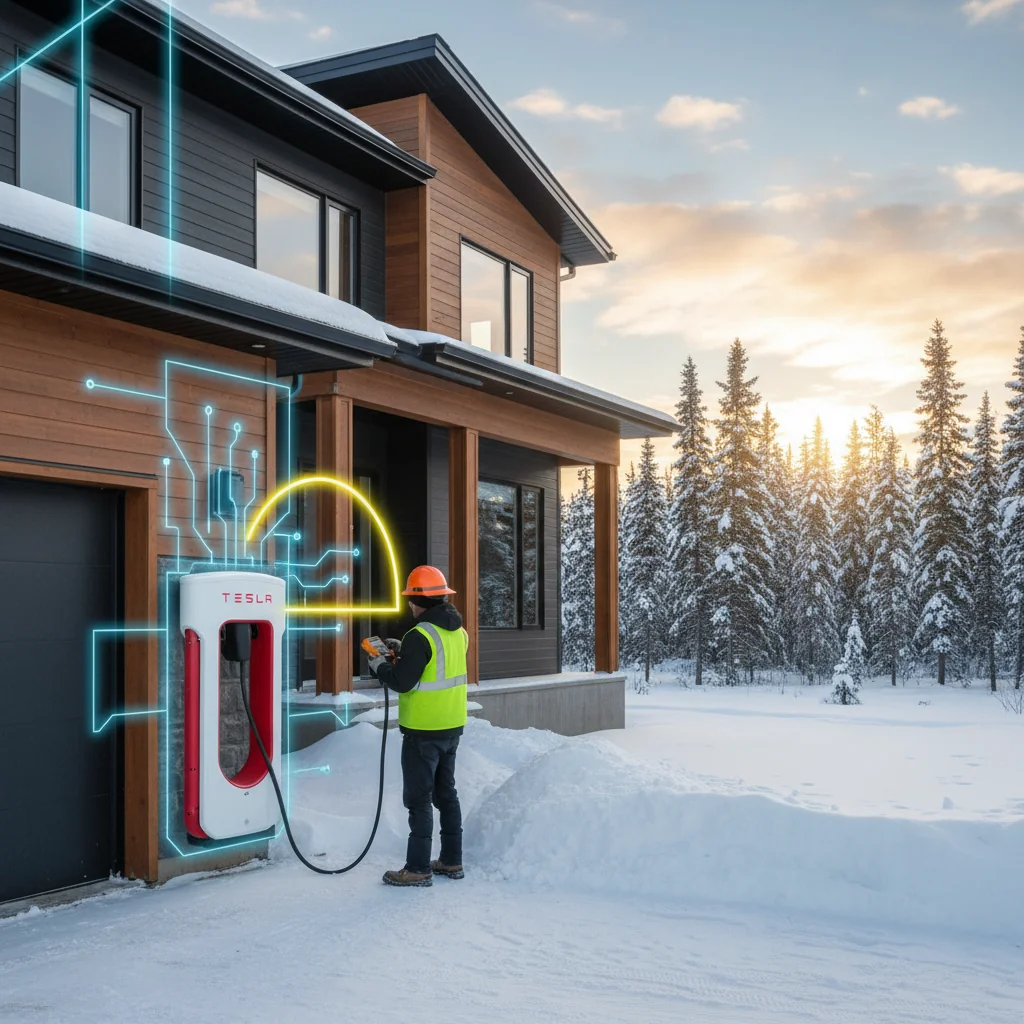
Tesla & Level 2 EV Charger Installation in Fort McMurray: The Complete Compliance Guide
Plugging a new Tesla into a standard wall outlet in a Fort McMurray December adds only a few kilometres of range per hour. For most Wood Buffalo drivers, a dedicated 240V Level 2 circuit is the practical way to start every morning with a charged, pre-warmed vehicle.
I'm Mohammad, an Alberta-licensed Master Electrician (Licence #8368) and owner of Crescent Electric, with 12+ years in the trade. This guide explains what the charging hardware can actually draw, how the Mobile Connector and Wall Connector differ, and how load management lets many homes add charging without a service upgrade.
Important: Tesla changes hardware and settings over time. Always confirm the current specifications in Tesla's installation manual and owner documentation for the exact model you own. Final circuit sizing depends on a load calculation for your home and the permit inspector's review.
Understanding Tesla Home Charging Options
1. Mobile Connector on a 120V outlet (Level 1)
Tesla's Mobile Connector with the standard 120V adapter draws about 12 amps. Expect roughly 5–8 km of range per hour. It is useful for occasional top-ups but rarely enough as a primary winter charging method in northern Alberta.
2. Mobile Connector on a 240V outlet (NEMA 14-50)
With the NEMA 14-50 adapter on a dedicated 50-amp circuit, Tesla's current Mobile Connector is limited to a maximum of 32 amps. The vehicle reads the adapter and sets the current automatically; a larger outlet or circuit does not make it charge faster. Older or third-party mobile units may have different ratings, so identify your exact unit before planning the circuit.
A 240V outlet used for EV charging must be suitably rated for repeated, long-duration use and installed under permit. Worn or low-quality receptacles are a common source of heat damage.
3. Tesla Wall Connector (hardwired)
The current Tesla Wall Connector delivers a maximum of 48 amps. It is hardwired to a dedicated 240V circuit, and the electrician sets its maximum current during commissioning to match the installed breaker and conductors.
48 A versus "80 A or 100 A" — clearing up the confusion
You may see 80 A or 100 A mentioned online. Those numbers do not describe the current Wall Connector's charging output:
- 48 A is the Wall Connector's maximum charging current. It is normally supplied from a 60 A breaker, because an EV charger is treated as a continuous load and the circuit is sized at 125% of the charging current (48 A × 1.25 = 60 A).
- 80 A appears as the rating of some older Tesla hardware and some vehicles' onboard chargers. It does not apply to the current Wall Connector.
- 100 A is commonly a home service size (the main breaker for the whole house), not a charger setting.
The vehicle also limits charging speed. A car with a smaller onboard charger will not charge faster on a 48 A Wall Connector than its own limit allows.
Continuous loads and the load calculation
EV charging is covered by Section 86 of the Canadian Electrical Code, and a charger can run at full current for hours. That is why the breaker and wiring are sized above the charging current, and why the charger must be included in a load calculation for your home's service (see CEC Rule 8-104 on maximum circuit loading). CEC Rule 86-302 requires the branch circuit breaker and supply conductors to be sized at 125% of the charger's maximum output.
Per CEC Rule 8-200, the EV charging load is added to your home's total demand at a 100% demand factor.
Before adding a circuit, we calculate whether your existing service can support the new load. Available panel space alone does not mean the service has capacity. Many older homes on 100 A service need either load management, a reduced charging setting, or a service upgrade. Which option fits depends on your actual appliances and the calculation, not on the neighbourhood.
Adjustable charging settings
The Wall Connector's maximum current is chosen at installation and must match the circuit. Under Alberta STANDATA 24-ECI-086, if a charger's current can easily be changed by the homeowner through an app, the load calculation must use the device's maximum rating. The exception is a limit set with an internal physical dip-switch by an electrician, together with permanent labelling at the panel showing the locked-in setting.
Load management options for homes with limited capacity
Option 1: An electric vehicle energy management system (EVEMS)
The RVE DCC-9 (and the newer DCC-10 with a built-in 60 A breaker) is an EVEMS under CEC Rule 8-500. It monitors the main service current with a CT clamp and interrupts the EV circuit whenever total household demand approaches the service rating, then re-energizes the charger when the load drops.
Because the DCC operates as a demand-management device, CEC Rule 8-106(10) allows a Tesla Wall Connector to be connected to a 100 A service without including the EV load in the service calculation. For many homes, that avoids a service upgrade.
Option 2: Tesla Wall Connector power sharing
Two or more current Wall Connectors can share one supply circuit. The units divide the available current between the connected vehicles so the combined draw stays within the circuit's rating. Power sharing manages the chargers on that shared circuit; it does not monitor the rest of your home's electrical use. It is a solution for two-EV households, not a substitute for whole-home load management.
Option 3: A lower-amperage circuit
On a constrained service, the Wall Connector can be installed on a smaller circuit, such as 32 A charging on a 40 A breaker, with the maximum current set at commissioning to match. For many daily commutes, overnight charging at a reduced rate is enough. We label the setting and record it for future inspection.
Outdoor installations for homes without a garage
Driveway or carport installations need weather-rated equipment, protection from vehicle impact, and buried or surface wiring installed to code depth and protection requirements. Freeze-thaw movement and snow clearing are real concerns in Wood Buffalo. We plan the route, enclosure and protection on site.
Trenching: Conduit must be buried a minimum of 600 mm below finished grade per CEC Rule 12-012, or 450 mm if mechanically protected with a 50 mm concrete cap.
Pedestal enclosure: We specify gasketed NEMA 4X enclosures such as Hoffman A-FRP or Stahlin J-series for Fort McMurray's freeze-thaw cycles.
Battery backup: Charging can be paired with a Tesla Powerwall 3 or Enphase IQ Battery 5P system so essential loads and charging continue during grid outages.
Step-by-step installation planning
Step 1: Choose your equipment
Decide between a hardwired Wall Connector (up to 48 A) or a NEMA 14-50 outlet for a Mobile Connector (up to 32 A), based on your vehicle and daily driving.
Step 2: Load calculation
We check your service capacity and recommend direct connection, load management, a reduced setting or a service upgrade. Try our load calculator for a first estimate.
Step 3: Permit and inspection
Permanent electrical work requires a permit in Alberta under the Alberta Safety Codes Act. We arrange the permit and inspection. See our permit application page, EV charger installation service or panel upgrade service.
Safety Disclaimer
EV charger installation is high-current electrical work that must be performed by a licensed electrician under a valid permit. This article is general information. Your installation depends on your equipment's current manufacturer instructions, your home's load calculation and the inspector's review.
Frequently Asked Questions
Can I install a Tesla charger on a 100-amp panel?
Often, yes. Depending on the load calculation, options include a DCC-10 load-management device, a Wall Connector limited with an internal dip-switch (per STANDATA 24-ECI-086), a reduced-current circuit, or a service upgrade. We confirm which applies after reviewing your home.
Will a NEMA 14-50 outlet charge as fast as a Wall Connector?
No. Tesla's current Mobile Connector is limited to 32 A on a NEMA 14-50 outlet, while the Wall Connector can deliver up to 48 A if the circuit and vehicle support it.
Do I need a permit for an EV charger in Fort McMurray?
Yes. Permanent electrical additions require an electrical permit and inspection.
About the Author
Mohammad is an Alberta-licensed Master Electrician (Licence #8368), Red Seal certified, with 12+ years of experience, and the owner of Crescent Electric in Wood Buffalo.
Call Mohammad at (587) 557-5494 or book a load calculation assessment online.
RELATED TOPICS:
