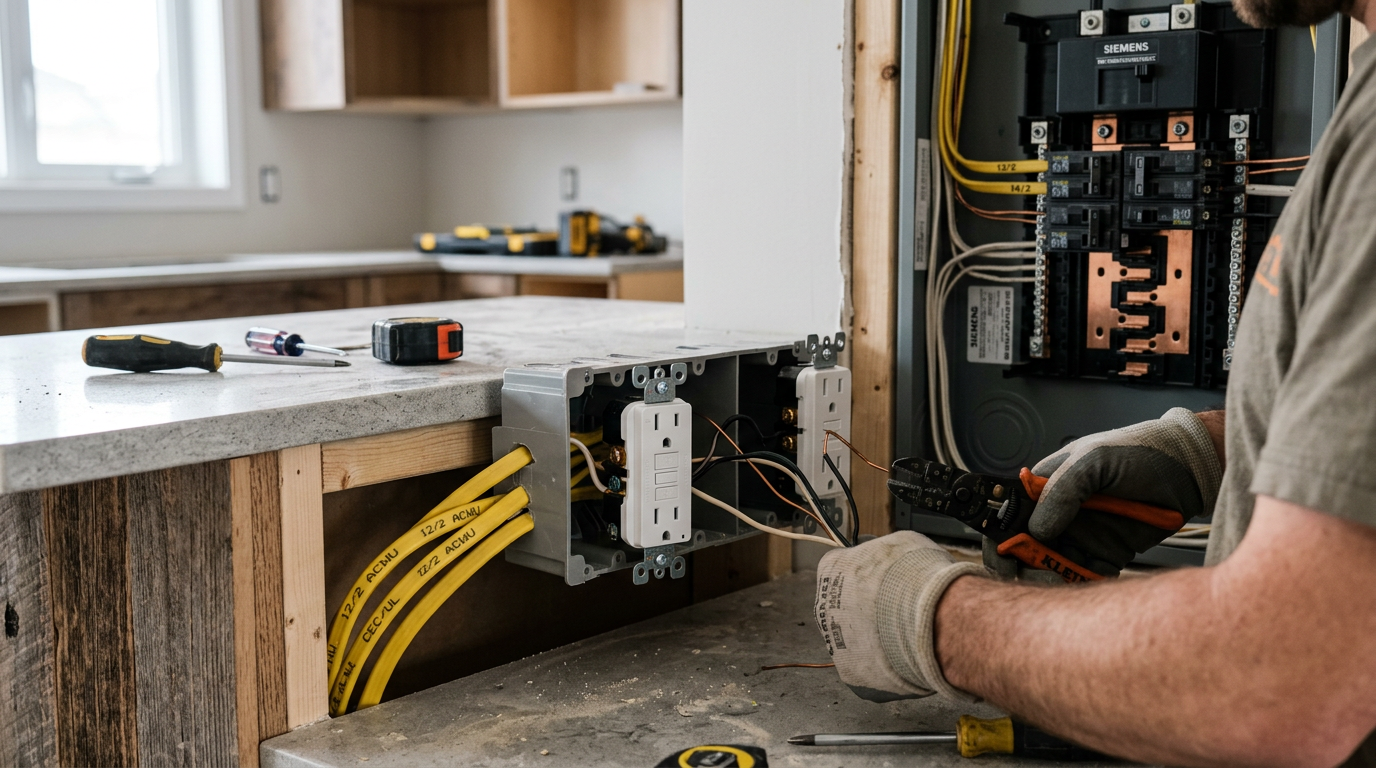
As an Alberta Master Electrician with more than a decade of hands-on experience in the Wood Buffalo region, I have stepped into hundreds of homes across Timberlea, Thickwood, and Eagle Ridge. Many of these visits begin with a homeowner planning their dream kitchen remodel. A kitchen is no longer just a place to boil water; it is the high-energy hub of the modern home. For our local oil-sands shift workers who return home in the middle of a freezing -40°C winter night, a reliable, safe, and highly functional kitchen is absolute heaven.
However, powering today’s high-wattage culinary appliances requires serious planning. Kitchens demand more electrical infrastructure than almost any other room in your house. If your home was built in the 1970s or 1980s, your existing system is likely unprepared for modern induction cooktops, built-in espresso machines, and high-draw microwaves. When planning your renovation, understanding the technical rules for kitchen wiring Fort McMurray and the exact kitchen counter receptacle code is essential to ensure your home passes inspection, functions flawlessly, and protects your family.
What Are the Kitchen Counter Receptacle Code Requirements?
When laying out your kitchen countertops, receptacle placement is not a matter of personal preference—it is strictly dictated by the Canadian Electrical Code to prevent the dangerous practice of running extension cords across cooking surfaces. Under Rule 26-700 / 26-722 / 26-724, there are very specific spatial requirements for counter receptacles that we must follow during any remodel.
The general rule is that no point along the wall line of a kitchen counter can be more than 900 mm (about 3 feet) from a receptacle. This means you must install receptacles such that any appliance with a standard 3-foot power cord can reach an outlet without stretching. If you have a stretch of counter broken by a sink or a stovetop, each side of that appliance or sink is treated as an independent counter space and must be wired accordingly. Any counter space that is 300 mm (12 inches) or wider requires its own dedicated receptacle.
Island and Peninsula Receptacle Rules
Kitchen islands and peninsulas are incredibly popular in modern open-concept layouts in newer neighbourhoods like Parsons Creek. The Canadian Electrical Code has specific rules for these surfaces under Rule 26-700 / 26-722 / 26-724:
- Fixed Islands: A fixed kitchen island must have at least one receptacle installed. If the island is particularly large or divided by a cooktop or sink, additional receptacles are required to ensure no point along the counter edge is too far from an outlet.
- Peninsulas: A peninsula counter (connected to a wall at one end) must have at least one receptacle installed. This outlet must be located within the peninsula footprint, rather than relying on the wall outlet where the peninsula connects.
Additionally, all electrical materials we install—from the box to the device itself—must carry an recognized Canadian safety mark like CSA or cUL, in strict compliance with Rule 2-024. We regularly use heavy-duty commercial-grade receptacles from manufacturers like Leviton and Hubbell to ensure they survive the daily wear and tear of busy family life.
Why Are Dedicated Circuits Vital for Modern Kitchens?
Have you ever tried to run a toaster oven and a microwave at the same time, only to have your kitchen suddenly go dark? This common headache occurs when high-draw appliances share a single circuit, leading to overloaded circuits. Modern code prevents this by requiring dedicated circuits for heavy-duty appliances.
A dedicated circuit means that one specific breaker in your main electrical panel serves exactly one appliance. In a standard kitchen renovation, the Canadian Electrical Code requires dedicated circuits for the following:
- The Refrigerator: Must be on a dedicated circuit to prevent food spoilage if another appliance trips a shared breaker.
- The Microwave: Modern over-the-range microwave ovens draw massive current and require their own dedicated 15A or 20A circuit.
- The Dishwasher: Must be wired on a separate circuit to handle its internal water heater and motor cycles safely.
- The Range/Oven: Typically requires a heavy-gauge 120/240V dedicated circuit.
When designing these systems, we carefully calculate electrical loads using Rule 8-104 to ensure the continuous load on any circuit does not exceed 80% of its rated capacity. We also cross-reference Rule 14-104 to guarantee that the overcurrent device (the breaker) is properly matched to the gauge of the copper wire running through your walls. Skimping on these details is a major safety hazard that can lead to electrical fires behind your beautiful new drywall.
If you live in an older property in Thickwood or Abasand, your existing panel may not have the physical space or the overall amperage capacity to support these additional dedicated circuits. In these situations, homeowners often need to explore our electrical panel upgrade service. Upgrading your panel ensures you have the capacity to feed your new kitchen safely, and you can learn more about this process in our comprehensive electrical panel upgrade guide.
How Do GFCI and AFCI Protection Keep Your Family Safe?
Water and electricity are a lethal combination. Because kitchen counters feature sinks alongside high-wattage electrical appliances, robust shock and arc protection is non-negotiable.
Ground Fault Circuit Interrupter (GFCI) Protection
Under the Canadian Electrical Code, specifically Rule 26-700 / 26-722 / 26-724, any receptacle installed within 1.5 meters of a kitchen sink must be GFCI-protected. A GFCI works by constantly monitoring the current leaving the hot wire and returning on the neutral. If it detects an imbalance as small as 4 to 6 milliamperes—indicating that electricity is escaping, potentially through water or a human body—it cuts power in milliseconds.
When we wire your kitchen, we often install GFCI receptacles directly at the first outlet on the circuit, protecting all downstream receptacles. Alternatively, we can install a dedicated GFCI circuit breaker in your electrical panel (from trusted manufacturers such as Siemens, Eaton, or Square D) to protect the entire line. This is a crucial safety upgrade, especially in older homes where outlets near sinks were never updated.
Arc Fault Circuit Interrupter (AFCI) Protection
While GFCIs protect against shock, Arc Fault Circuit Interrupters (AFCIs) protect against electrical fires. An arc fault occurs when damaged, loose, or corroded wiring creates an unintended electrical spark. This sparking generates intense heat that can ignite nearby insulation or wood studs.
Modern Alberta Electrical STANDATA and Canadian Electrical Code rules require AFCI protection on almost all 125V, single-phase, 15A and 20A receptacles in residential kitchen renovations, with limited exceptions (such as the refrigerator receptacle under certain conditions). Utilizing dual-function AFCI/GFCI breakers is now standard practice for professional electricians, ensuring your kitchen complies with both safety requirements simultaneously.
How Do Wood Buffalo Climate and Shift Work Patterns Impact Kitchen Design?
Living and working in Fort McMurray introduces unique challenges that don't apply to warmer southern regions. Our winters are long, dark, and bitterly cold, with temperatures regularly dropping below -40°C. During these months, we spend the vast majority of our time indoors. The kitchen becomes a focal point of comfort, warmth, and heavy meal preparation.
Additionally, our community is defined by the oil-sands industry. Shift workers at sites like Base Plant, Syncrude, or Albian Sands operate on intensive schedules. When you get home from a 12-hour shift at 4:00 AM, you want a kitchen that works instantly and efficiently. You might have an electric kettle, an air fryer, and a high-end coffee maker all running at the exact same moment. If your kitchen wiring is outdated, this morning routine will repeatedly trip your breakers, causing frustration when you least need it.
When we plan your kitchen layout, we design it to support this heavy, simultaneous appliance usage. We ensure that your counter receptacles are split across multiple 20-amp circuits. This means your high-wattage air fryer and your espresso machine won't be competing for power on the exact same circuit breaker, giving you a seamless, disruption-free morning before or after your shift.
If you ever find yourself facing a sudden power outage or a tripped breaker that refuses to reset in the dead of winter, do not hesitate to contact our team. We provide rapid assistance as your go-to emergency electrician in Fort McMurray to keep your home warm, safe, and fully powered.
What Should You Consider Before Starting Your Kitchen Renovation?
Before you demolish a single cabinet or purchase your new appliances, there is a checklist of critical electrical steps you should take to ensure your project is a complete success:
- Inventory Your Appliances: Make a complete list of all the appliances you plan to install, including their voltage and wattage requirements. An induction range, for example, has significantly different power needs than a standard electric coil range.
- Assess Your Current Panel: Open your electrical panel door. Is it full? Is it a legacy brand that has been subject to safety recalls? A successful kitchen remodel often requires anywhere from 4 to 8 new circuits, which may necessitate a panel upgrade or subpanel installation.
- Plan for Auxiliary Electrical Systems: A modern kitchen often includes more than just counter outlets. Think about under-cabinet LED lighting, USB charging ports built into the island, or even preparing your garage for future technology by checking out our ev charger installation options or integrating a backup power system like our generator installation services.
- Protect Your Investment: Modern kitchen appliances are highly computerized and sensitive to voltage spikes. To protect your brand-new refrigerator, oven, and microwave from damage, we highly recommend installing a whole-home surge protector. Learn more about protecting your electrical system with our wholehouse surge protection services.
By mapping out these requirements early, you can avoid costly change orders and delays once the construction phase of your renovation is underway.
Disclaimer: Always pull the required permit and hire a licensed electrician. This work falls under the Alberta Safety Codes Act. Attempting to complete DIY electrical work without proper certification can void your home insurance, pose significant safety hazards, and violate provincial law.
About the Author
Mohammad — Alberta Master Electrician (License #8368)
I am a Red Seal certified Master Electrician with over 12 years of hands-on experience providing electrical solutions to homeowners and businesses throughout the Regional Municipality of Wood Buffalo. Throughout my career, I have specialized in residential renovations, complex electrical code compliance, and reliable cold-weather installations. At Crescent Electric, we pride ourselves on being fully licensed, carrying $5 million in liability insurance, pulling all required local permits, and delivering fully compliant installations under the Alberta Safety Codes Act. Whether you are remodeling a heritage home in Thickwood or building a new space in Parsons Creek, my goal is to provide safe, durable, and highly efficient electrical systems tailored to the unique lifestyle of our Fort McMurray community.
