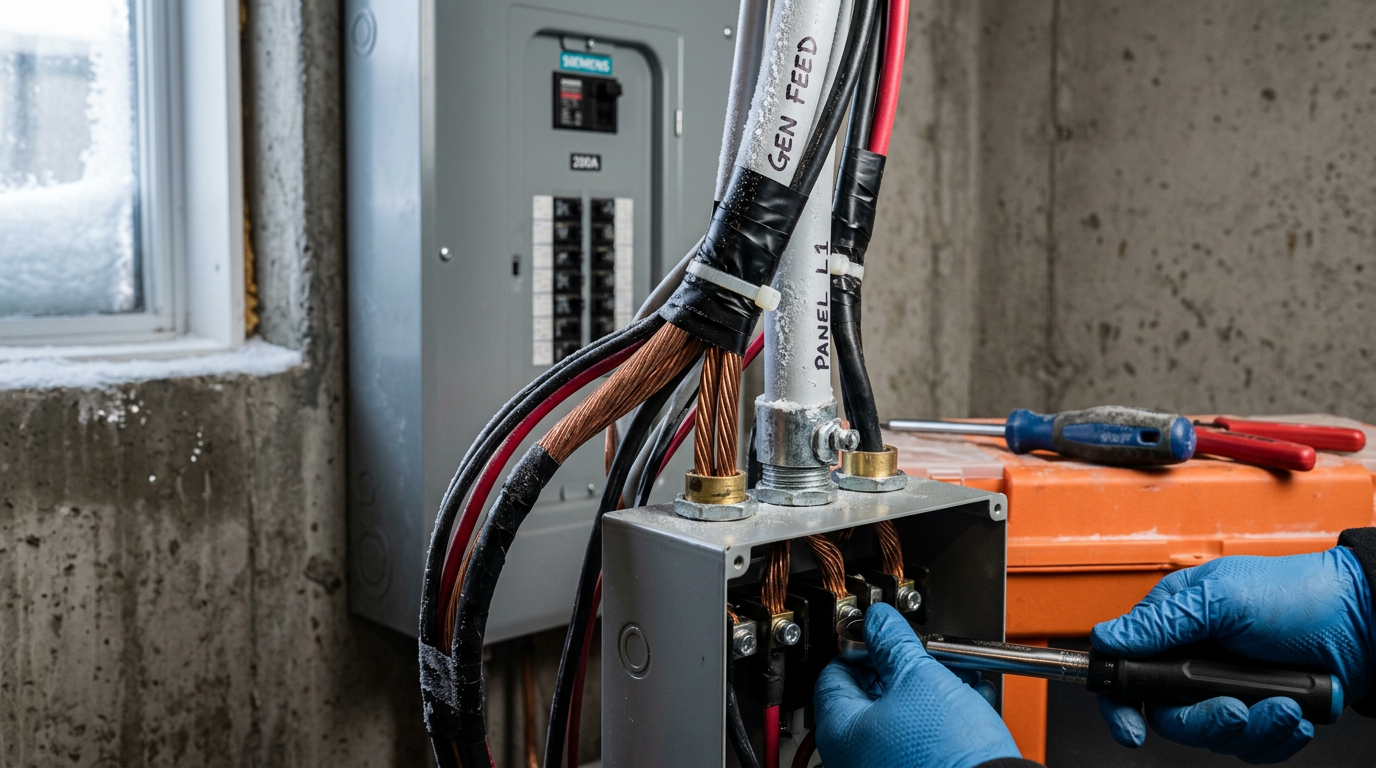
When a winter storm hits the Regional Municipality of Wood Buffalo, our power grid is put to the ultimate test. As a Master Electrician operating in northern Alberta, I have seen firsthand how quickly a routine winter evening can turn into a critical emergency when the power drops. In neighborhoods like Timberlea, Thickwood, and Abasand, temperatures regularly plunge below -40°C. In these extreme conditions, your home is only hours away from freezing pipes, structural damage, and unsafe indoor living conditions. For many families—especially those with oil-sands shift workers who are away from home for days at a time—installing a reliable standby generator is not a luxury; it is a critical safety investment.
However, simply purchasing a generator off the shelf or choosing the biggest model available without a plan is a recipe for system failure. Properly sizing a standby generator requires a precise understanding of your home's electrical demand, the physical behavior of motor loads in sub-zero temperatures, and strict adherence to the Canadian Electrical Code. If your backup power system is too small, it will trip its breakers when you need it most. If it is oversized, you will waste precious fuel and run the risk of "wet stacking" or damaging the unit's engine. Let us walk through the technical process of sizing a standby generator to ensure your home remains safe, warm, and fully operational through any outage.
Why is correct generator sizing critical for our local climate?
In milder parts of Canada, a backup generator might only be needed to keep a couple of lights on and run a refrigerator. In Fort McMurray, our backup power systems have to work significantly harder. When the grid goes offline in the middle of a deep freeze, your primary heating system is the first thing that must be protected. Whether you heat your home with a natural gas furnace or an electric hydronic system, the blowers, pumps, and control boards require continuous, stable electricity. If you want to learn more about keeping your system running safely during the coldest months, check out our guide on winter electrical safety.
Undersizing your standby generator poses several severe risks:
- Nuisance Tripping: When a heavy load, such as your furnace blower or water pump, attempts to start up on an overloaded generator, the voltage drop will cause the generator's overcurrent device to trip. This leaves you completely in the dark and without heat until you go outside in -40°C weather to manually reset the system.
- Voltage Fluctuations: An overloaded generator will struggle to maintain its output voltage and frequency. These fluctuations can easily destroy sensitive microprocessors in your smart thermostat, modern furnace control boards, and home computers.
- Premature Engine Wear: Running a generator constantly at 100% capacity accelerates engine wear, reduces fuel efficiency, and can cause the alternator components to overheat and fail prematurely.
To avoid these pitfalls, we must carefully calculate both your continuous load requirements and your peak starting requirements. We then match those demands against the continuous operating ratings of the generator, applying the safety margins required by provincial safety standards.
How do you calculate your home's winter emergency load?
The first step in sizing your home standby generator is performing a comprehensive electrical load calculation. We classify your household electrical demands into two distinct categories: essential loads (the bare minimum required to protect your home from freezing and maintain basic safety) and managed loads (appliances that can be run selectively or managed by an automatic power management system).
Under the Canadian Electrical Code, specific rules guide how we calculate and apply continuous loads. According to Rule 8-104 (continuous load 80%), we must ensure that our electrical distribution systems are not subjected to continuous loads exceeding 80% of the rated capacity of the overcurrent devices, unless specifically rated otherwise. We apply these same engineering principles to your generator's output. To keep your backup system operating reliably, we target a continuous operating load that does not exceed 80% of the generator's rated prime capacity.
To begin your calculation, list the essential devices you must run during a winter outage:
- Forced-Air Furnace Blower Motor (typically 1/3 HP to 3/4 HP): 800 to 1,200 running watts (with up to 3,000 starting watts).
- Sump Pump (essential during spring melts or heavy rains in Eagle Ridge): 800 running watts (with up to 2,500 starting watts).
- Refrigerator and Deep Freezer: 700 running watts each (with up to 2,200 starting watts for compressor startup).
- Basic Lighting (LED bulbs throughout the home): 100 to 300 watts.
- Water Heater (if natural gas with a power vent or electronic ignition): 100 to 500 watts. If you have an electric water heater, it will require 3,000 to 4,500 running watts, which significantly changes your generator requirements.
- Well Pump (for properties in Anzac or rural Wood Buffalo): 1,000 running watts (with up to 3,000 starting watts).
If your home's existing service panel is crowded, outdated, or lacks the physical space to integrate a transfer switch safely, you may need to address these issues before installing a generator. You can read more about this in our article on overloaded circuits and explore our dedicated electrical panel upgrade service to ensure your primary service is ready to handle the addition of a standby backup system.
What is the difference between starting wattage and running wattage?
One of the most common mistakes homeowners make when purchasing a generator is looking only at "running watts" (also known as rated watts) and ignoring "starting watts" (also known as surge watts). Running wattage is the continuous power your appliances consume to operate normally once they are up and running. Starting wattage is the brief, intense burst of power required to get electric motors spinning from a complete stop.
Devices with electric motors, such as your furnace blower, refrigerator compressor, sump pump, and air conditioner, are inductive loads. When an inductive motor starts up, it experiences "inrush current," which can require three to five times more power than its normal running wattage for the first few seconds. If your standby generator cannot deliver this surge of power, the motor will stall, the generator voltage will sag, and the system's internal safety controls will trip the breaker.
When sizing the protection for these circuits, we closely follow Rule 14-104 (overcurrent device rating) to ensure that the overcurrent devices are correctly matched to protect the conductors while still allowing for these momentary motor-starting inrush currents. Additionally, we must consider high-draw modern loads such as electric vehicle supply equipment (EVSE). If you own an electric vehicle in Parsons Creek, you must account for Section 86 (EV/EVSE) of the Canadian Electrical Code, which governs how EV charging loads are calculated and connected. Because EV chargers represent a massive, continuous resistive load (often 7,200 to 11,500 watts), we typically configure transfer switches to automatically shed or lock out EV charging circuits when the home is operating on standby generator power, preventing the generator from immediately overloading.
How do transfer switches affect your generator selection?
A standby generator cannot simply be plugged into a standard wall outlet. Doing so is extremely dangerous, illegal, and causes "backfeeding," which sends high-voltage electricity back through your utility lines, putting ATCO Electric utility linemen at risk of electrocution. To safely connect a standby generator to your home, a dedicated transfer switch must be installed.
A transfer switch acts as a safety gatekeeper, physically preventing your home from being connected to both the utility grid and the generator at the same time. There are two primary types of transfer switches:
- Manual Transfer Switches: These require you to manually flip a switch to isolate your home from the grid and connect it to the generator. While cost-effective, they require you to be physically present at home to restore power. For shift workers working long hours at an oil-sands site, a manual switch is not practical if their family is left at home in a deep freeze.
- Automatic Transfer Switches (ATS): An ATS constantly monitors utility power. Within seconds of detecting a utility outage, the ATS commands the standby generator to start, warms up the engine, isolates your home from the utility grid, and connects the generator load automatically. This ensures your home maintains heat even if you are away at work or sleeping.
When selecting and installing transfer switches and associated distribution equipment, we strictly utilize high-quality manufacturers such as Siemens, Eaton, and Schneider Electric. All components must bear a recognized approval marking under Rule 2-024 (approval marking) to ensure they have been tested and certified for safe use in Canadian electrical installations.
Furthermore, proper grounding is critical when integrating a generator with your home's electrical system. We follow the Rule 10-700 series (bonding/grounding) to establish a solid grounding path. Depending on whether the generator is configured as a "separately derived system" or a "non-separately derived system," the neutral conductor must be bonded or isolated correctly. Improper grounding can lead to severe shock hazards, ground faults, or the failure of your home's surge protection. To learn more about protecting your home's valuable electronics during power transitions, see our whole-house surge protection service.
Why should you avoid DIY generator installations?
Sizing and installing a standby generator is a complex task that involves high-voltage electrical wiring, fuel line integration (natural gas or liquid propane), and precise code compliance. It is not a weekend DIY project. A poorly installed system can result in carbon monoxide poisoning, house fires, voided equipment warranties, and denied insurance claims. Additionally, working with high-voltage service entry conductors carries a severe risk of arc flash and electrocution.
When executing these installations, we ensure that every code requirement is met, including Rule 6-206 (service conductor sizing) to handle the incoming power distribution safely. We also ensure that any outdoor electrical components, such as generator plugs or auxiliary control boxes, meet the requirements of Rule 26-700 / 26-722 / 26-724 (receptacles, TR, GFCI) to protect against moisture, snow accumulation, and freezing wind.
If you experience any sudden electrical failures, flickering lights, or breaker issues during a storm, do not attempt to fix them yourself. You can rely on our team for emergency electrician services in Fort McMurray to quickly resolve issues and keep your family safe.
To schedule a professional assessment of your home's backup power needs, visit our dedicated generator installation service page. We will calculate your electrical load, help you choose the ideal system size, and manage the entire installation process from start to finish.
Disclaimer: Always pull the required permit and hire a licensed electrician. This work falls under the Alberta Safety Codes Act.
About the Author
Mohammad — Alberta Master Electrician (License #8368), Red Seal
With over 12 years of hands-on electrical experience serving the Wood Buffalo region, Mohammad is an expert in cold-weather electrical systems, industrial-grade residential backup power, and complex control systems. As a Red Seal certified electrician, he is dedicated to delivering safe, reliable, and fully code-compliant electrical installations that stand up to the harshest northern winters.
