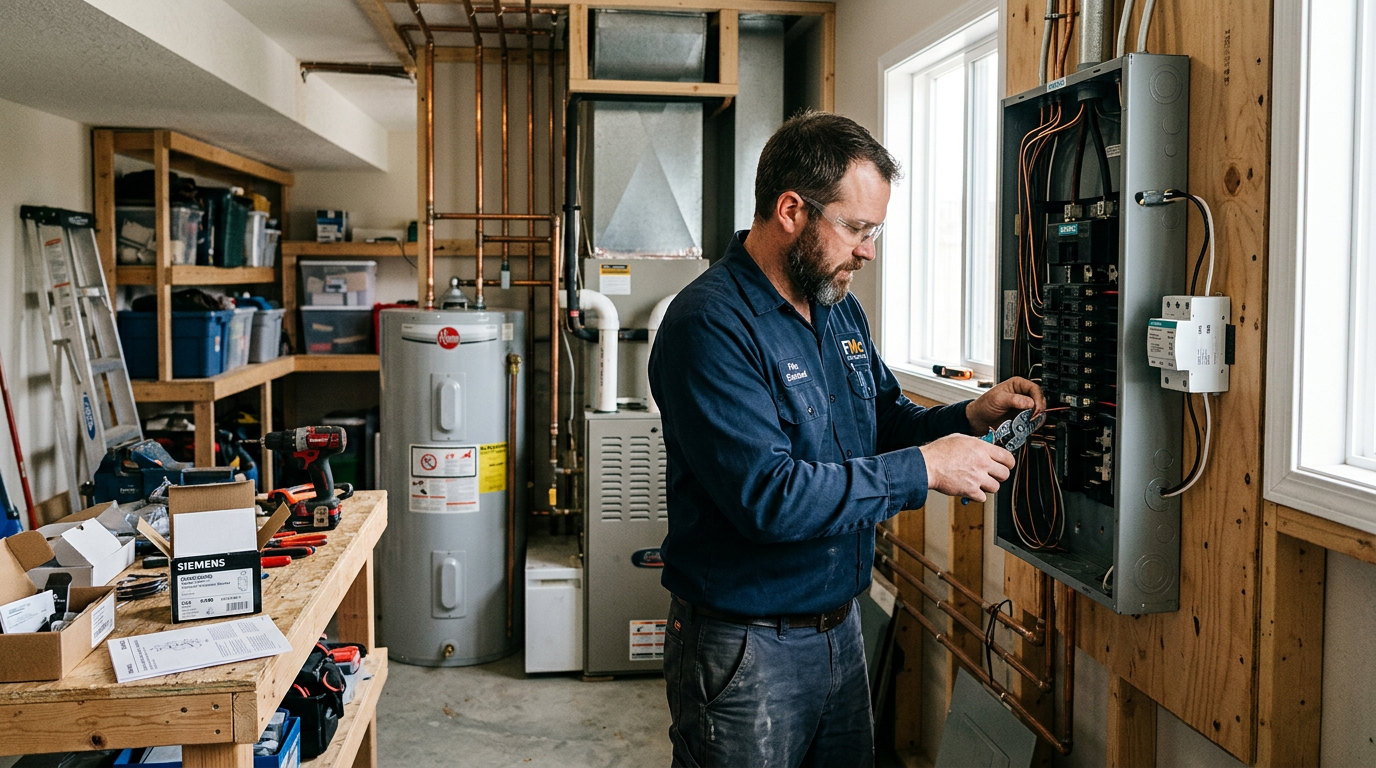
My name is Mohammad, and I am an Alberta Master Electrician (License #8368). Over the past 12+ years serving the Regional Municipality of Wood Buffalo, I have stood in dozens of utility rooms and kitchens across Timberlea, Thickwood, and Abasand. If there is one question I get asked more than any other by local oil-sands shift workers returning from a long stretch on-site, it is this: "Mohammad, every time I come home, my microwave and stove clocks are flashing. We get so many power blips here. Is a whole house surge protector actually worth it, or is it just an upsell?"
It is a completely fair question. When you live in a region where the outdoor temperature can plummet to -40°C in the dead of winter, your electrical system faces immense stress. The local grid works overtime, and when power fluctuates, your expensive appliances bear the brunt of the instability. In this comprehensive guide, we will break down the science of power surges, look at the unique challenges of the Alberta utility grid, and evaluate whether investing in commercial-grade home surge protection makes financial and safety sense for your property.
Why do we experience so many power blips in Wood Buffalo?
To understand whether surge protection is worth it, we first have to look at why our local power supply can feel so unstable. Our electrical grid in northern Alberta is incredibly unique. We are connected to a high-voltage transmission system that spans vast distances across heavily forested terrain to deliver power to the Wood Buffalo region. This geography exposes our power lines to severe environmental factors, from heavy snow loads and windstorms to lightning and wildlife interference.
Furthermore, our local grid operates alongside massive industrial operations. The heavy industrial facilities and oil sands sites in our region draw and switch enormous electrical loads. When these massive industrial facilities transition heavy machinery online or offline, it can cause transient voltage fluctuations that ripple back through the residential distribution network. If you live in neighborhoods like Eagle Ridge or Parsons Creek, you might notice these transitions as brief, split-second flickering lights or momentary dropouts.
Winter grid strain is another major factor. When temperatures drop to -40°C, residential heating systems, block heaters, and commercial HVAC units run continuously. This extreme power demand strains neighborhood distribution transformers. When a transformer experiences localized stress or when power is restored after a seasonal outage, a massive rush of electricity—known as a voltage surge—can enter your home's main panel. If you want to protect your system from these harsh winter elements, exploring our resources on winter electrical safety can help you understand how cold weather affects your home's infrastructure.
How do power surges actually damage your home electronics?
Many homeowners think of a power surge as a dramatic event—like a direct lightning strike during a summer storm that blows the outlets off the walls. While lightning strikes certainly cause catastrophic damage, they represent only a tiny fraction of the electrical surges your home experiences. The far more common, silent threat comes from low-level transient voltage spikes.
A standard residential electrical system in Alberta delivers a nominal 120 volts of alternating current. However, this voltage is not a perfectly flat line; it flows in a wave. A surge occurs when the voltage spikes significantly above this nominal level. These spikes can range from a few hundred volts to thousands of volts, lasting only a fraction of a millisecond.
Modern homes are filled with highly sensitive microprocessors. Your smart refrigerator, high-efficiency washing machine, LED television, computer, and even your home automation systems rely on tiny silicon chips. These chips are designed to operate within a very tight voltage tolerance. When a micro-surge hits these components, it does not always cause them to fail immediately. Instead, it causes "electronic rust"—a gradual degradation of the internal circuitry. Over months or years, these repeated micro-surges overheat the microscopic pathways inside the chips, eventually leading to mysterious appliance failures where the control board simply stops working without warning.
What is a whole house surge protector and how does it work?
A whole house surge protector is a specialized device installed directly at your main electrical service panel. Unlike standard power strips that you plug into a wall outlet, a panel-mounted surge protective device (SPD) acts as a heavy-duty gateway guardian for your entire home.
The device is continuously monitoring the incoming voltage from the utility provider. Under normal conditions, it sits quietly, allowing standard current to flow freely through your breakers to your household circuits. However, the moment the incoming voltage exceeds a safe threshold (typically around 15% above the standard operating voltage), the surge protector springs into action in nanoseconds.
Using components called Metal Oxide Varistors (MOVs), the protector instantly diverts the excess high-voltage energy away from your active branch circuits and channels it safely down your home's grounding system into the earth. Once the voltage wave returns to normal levels, the device resets itself automatically, ready for the next event. By intercepting the surge at the main entry point, it ensures that high voltage never reaches your outlets, switches, or hardwired appliances.
Is surge protection Alberta homeowners invest in actually worth the cost?
To determine if surge protection is truly worth the investment, we have to look at the numbers. Consider the total replacement value of the electronic equipment and smart appliances currently plugged into your home. A typical household in neighborhoods like Timberlea or Wood Buffalo often contains:
- A high-efficiency furnace and central air conditioning unit ($6,000 – $12,000)
- Smart kitchen appliances, including your refrigerator, range, and dishwasher ($5,000 – $10,000)
- A modern laundry pair with electronic control boards ($2,000 – $4,000)
- Home entertainment systems, computers, and gaming consoles ($3,000 – $8,000)
- Smart home thermostats, security cameras, and lighting controls ($1,000 – $3,000)
In total, the average modern home contains between $17,000 and $37,000 worth of sensitive electronic equipment. If a major utility fault or transformer failure occurs nearby, all of these devices could be destroyed instantly. Even if you have home insurance, your deductible is likely between $1,000 and $2,500, not to mention the immense hassle of inventorying your damaged belongings, waiting for claims adjusters, and living without essential appliances for weeks.
By comparison, having a professional install a high-quality, commercial-grade Type 2 surge protector at your main panel is an incredibly cost-effective preventative measure. When you factor in the extended lifespan it grants to your day-to-day electronics by filtering out daily micro-surges, the device easily pays for itself within its first few years of service. It provides invaluable peace of mind, especially for shift workers who are away from home for several days at a time and cannot be there to unplug devices during a sudden storm or grid emergency.
How does the Canadian Electrical Code govern surge installation?
As a certified Red Seal electrician, my work is strictly guided by safety standards. Installing a surge protective device requires a thorough understanding of the Canadian Electrical Code (CEC) to ensure the installation is safe, reliable, and compliant with municipal guidelines. There are several key rules we must follow during this process:
Rule 2-024: Approval Markings
Under Rule 2-024, any surge protective device installed in an Alberta home must bear approved certification markings from an accredited testing agency, such as CSA or cUL. We only install premium, field-tested equipment from trusted industry manufacturers like Eaton, Square D, Siemens, and Schneider Electric. Using cheap, uncertified online imports violates the provincial safety standards and can pose a serious fire hazard inside your panel.
Rule 10-700 series: Bonding and Grounding
A surge protector is only as good as the grounding system it connects to. Because an SPD functions by redirecting excess current to the earth, we must inspect and verify your home's grounding system under the Rule 10-700 series. If your grounding electrode (ground rod or plate) is corroded, loose, or improperly bonded, the surge protector will have nowhere to send the high voltage, rendering it useless. We carefully test the ground path resistance to ensure the diverted energy can safely dissipate into the soil.
Rule 14-104: Overcurrent Device Rating
To safely connect a Type 2 surge protector to your busbars, we must install it on its own dedicated double-pole circuit breaker. Under Rule 14-104, we ensure that the overcurrent device rating and wire sizing match the manufacturer's strict specifications. This guarantees that if the surge protector itself ever experiences an internal failure or reaches the end of its useful life, the dedicated breaker will trip instantly, isolating the device from the rest of your panel and preventing a localized short circuit.
Rule 26-724: Branch Circuit Protection
While a whole-house unit provides excellent primary defense, the Canadian Electrical Code also recognizes the value of point-of-use protection. Under Rule 26-724, which outlines general receptacle requirements, we often recommend a two-stage approach: combining a panel-mounted Type 2 protector with Type 3 surge-protective receptacles (complying with Rule 26-700 / 26-722 / 26-724) at key locations like your home office or entertainment center. This dual-layer strategy catches external utility surges at the panel and internal surges right at the wall outlet.
How do you choose the right surge protection device for your panel?
Not all surge protectors are created equal. When selecting a device for your home, we analyze several critical technical specifications to ensure it matches your household needs and your existing electrical infrastructure. If your panel is outdated or completely full, you may first need to consider an electrical panel upgrade to accommodate the new device and ensure safe operation.
First, we look at the Surge Current Capacity, measured in kiloamps (kA). This rating tells us how much surge energy the device can safely redirect in a single event. For most residential properties in Wood Buffalo, we recommend a minimum rating of 50kA to 108kA per phase. This range offers a robust defense against standard utility spikes and nearby lighting activity without premature degradation of the internal MOVs.
Next, we evaluate the Voltage Protection Rating (VPR), which is the clamping voltage. This number indicates the maximum voltage the surge protector will allow to pass through to your branch circuits before it clamps down and diverts the energy. A lower VPR means better protection for your sensitive electronics.
Finally, we check the manufacturer's warranty. Many premium devices from Square D, Siemens, and Eaton come with connected equipment warranties. This means that if a properly installed surge protector fails to protect your plugged-in appliances during a surge event, the manufacturer will cover the repair or replacement costs up to a specified limit (often ranging from $25,000 to $75,000). This added layer of financial protection makes the installation an even more sensible choice for local homeowners.
If you are experiencing other electrical issues in your home, such as a breaker that keeps tripping, it is critical to address these underlying problems before installing a surge protective device. Our team of certified professionals can perform a comprehensive safety assessment of your panel to make sure your entire system is running efficiently and safely.
Disclaimer: Always pull the required permit and hire a licensed electrician. This work falls under the Alberta Safety Codes Act.
About the Author
Mohammad is an Alberta Master Electrician (License #8368) and Red Seal certified professional with over 12 years of hands-on experience in the electrical trade. Based in Fort McMurray, he specializes in residential and commercial electrical installations, panel upgrades, and surge protection solutions tailored for the extreme climates of the Regional Municipality of Wood Buffalo. Known for his technical precision, dedication to safety codes, and reliable customer service, Mohammad ensures every job is fully compliant with the Canadian Electrical Code and provincial safety regulations. If you suspect your home has been damaged by utility spikes, or if you need immediate assistance with a system failure, do not hesitate to contact our emergency electrician team for prompt, expert support.
