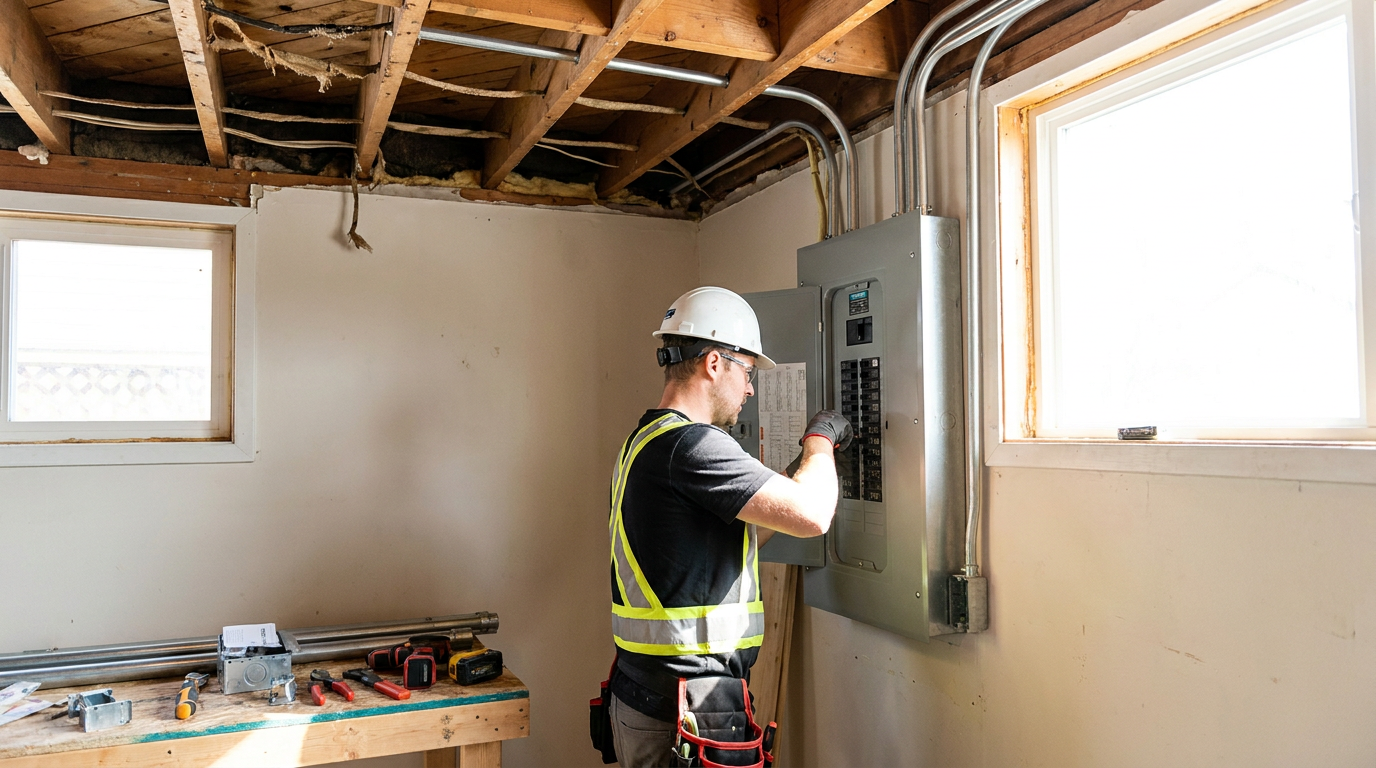
Fort McMurray is a young city by Canadian standards. Our residential stock largely dates from the oilsands booms of the late 1960s onward, which means the wiring problems we find here are very different from the ones you read about in Toronto, Winnipeg, or Vancouver. Homeowners often call worried about knob-and-tube wiring after reading a national article — but in more than twelve years of service calls across Wood Buffalo, true knob-and-tube is something I almost never see. What I do see, constantly, are aging distribution panels and outdated branch wiring that were fine in 1978 and are badly outmatched by a 2026 household.
As an Alberta Master Electrician working throughout Thickwood, Beacon Hill, Abasand, Timberlea, and Gregoire, I want to give you the accurate local picture: which legacy systems actually exist in Fort McMurray homes, why insurers care about them, and what a properly permitted upgrade looks like under the Canadian Electrical Code and the Alberta Safety Codes Act.
Is knob and tube wiring common in Fort McMurray homes?
No. Knob-and-tube (K&T) was the standard wiring method across North America from the late 1880s into the 1940s — single copper conductors suspended on porcelain knobs and passed through porcelain tubes in the framing. Fort McMurray's residential expansion happened decades after that method was abandoned, so unless you are dealing with a rare pre-war structure, your home does not have it. I would not plan a renovation budget around finding it.
The far more realistic finding in a mature Fort McMurray home is one of the following:
- Aging distribution panels. This is the number one legacy issue in our city. Older Federal Pacific Stab-Lok panels, early Sylvania and Commander loadcentres, and 60-amp or 100-amp fuse panels are still energized in plenty of homes. These panels have a poor field reputation for breakers that do not reliably trip, bus stab connections that loosen and overheat, and obsolete parts that are difficult or impossible to source. A scorched or discoloured bus stab behind a breaker is a finding we take seriously.
- Aluminum branch-circuit wiring. Widely installed in the 1960s and 1970s. Aluminum expands and contracts more than copper under load, which loosens terminations over time and creates heat at receptacles, switches, and panel lugs. See our detailed breakdown of aluminum wiring dangers.
- Ungrounded two-wire circuits. Older non-metallic sheathed cable with no equipment bonding conductor, often paired with three-prong receptacles that were swapped in without any ground behind them.
- Undersized services. A 60-amp or 100-amp service asked to carry a hot tub, an EV charger, a garage heater, and modern kitchen loads.
None of these were unsafe by the standards of their day. They are simply undersized and worn out relative to how we live now — block heaters, HRVs, electric heat, home offices, and fast chargers all pulling at once through -40 °C winter peaks.
Why do insurance companies flag old panels and old wiring?
The most common reason homeowners call me is a letter from an insurer. Underwriters operating in Alberta routinely refuse to write or renew a policy on a home with a Stab-Lok-style panel, a fuse panel, aluminum branch wiring, or ungrounded circuits — and they will typically want documentation from a licensed electrician before they reconsider.
Their objection is straightforward. An overcurrent device that may not open under fault conditions is the single worst failure mode in a house, because every other protection in the system assumes the breaker does its job. Similarly, ungrounded circuits have no low-impedance path back to the panel, so a fault inside an appliance can energize the appliance body, plumbing, or framing instead of clearing the circuit. Modern bonding and grounding requirements exist for exactly this reason and are covered by the Rule 10-700 series of the Canadian Electrical Code.
Add our climate to it: heating runs hard for months, loads sit near continuous, and loose aluminum terminations or degraded bus connections heat up under exactly those sustained conditions. Insurers price that risk accordingly.
What are the real safety risks in a legacy Fort McMurray home?
- Breakers that do not trip. On problem-era panels, a breaker can look and feel normal and still fail to open on an overload or short. This is the finding that most often turns into a same-week panel replacement.
- Overheating terminations. Aluminum branch wiring on devices not rated for it — or a breaker with a loose grip on the panel bus — produces heat at the connection. Warm cover plates, discoloured receptacles, and a faint burnt-plastic smell are all late-stage warnings.
- Oversized fuses and breakers. On fuse panels especially, a 20- or 30-amp fuse gets installed to stop nuisance blowing on 14 AWG conductors. That violates Rule 14-104 limits on overcurrent device ratings and makes the wire the weakest link.
- False grounds. Three-prong receptacles installed on ungrounded two-wire circuits give a false sense of safety and do not satisfy the receptacle requirements in Rule 26-700 / 26-722 / 26-724.
- Chronic overloading. Too few circuits for today's kitchen and garage loads leads to overloaded circuits and repeat nuisance tripping.
If you smell burning plastic, hear sizzling or buzzing at the panel, or see scorching around a breaker, shut the affected circuit off and call an emergency electrician fort mcmurray right away.
Panel replacement or full rewire — which do you actually need?
Most Fort McMurray homes need a panel and service upgrade, not a full rewire. A full rewire is the right call when the branch wiring itself is the problem — widespread aluminum on unrated devices, ungrounded circuits throughout, or heavy unpermitted DIY splicing. Here is how we approach it.
Step 1: Inspection and mapping
We open the panel, check the make and vintage, inspect the bus and every termination for heat damage, identify aluminum versus copper branch runs, and map which circuits are grounded. You get a clear list of what is failing versus what is simply old.
Step 2: Load calculation and circuit design
We run a proper calculation before sizing anything, applying continuous-load limits under Rule 8-104 and service sizing under Rule 6-206. You can preview your own numbers with our electrical load calculator before we arrive.
Step 3: Panel and service replacement
The old loadcentre comes out and a modern panel goes in — we standardize on Siemens, with Eaton, Square D, and Schneider Electric as alternates — typically moving a 60-amp or 100-amp service up to a 200-amp service with spare capacity for an EV charger or hot tub. Our electrical panel upgrade guide walks through the whole process.
Step 4: Branch wiring remediation or rewire
Where a full rewire is warranted, we fish modern grounded cable through existing cavities with minimal drywall disruption and decommission the old runs. Where aluminum is staying, we terminate it only on approved, compatible devices and connectors.
Step 5: Devices, protection, and finish
Tamper-resistant and GFCI receptacles are installed where required by Rule 26-700 / 26-722 / 26-724, AFCI protection goes into the new panel, and we recommend whole house surge protection to shield the new system from grid disturbances.
Permits, compliance, and cost in Alberta
Panel replacements and rewires are permitted work. Under the Alberta Safety Codes Act, an electrical permit must be taken out through the Regional Municipality of Wood Buffalo before the work starts, and the installation is inspected by a Safety Codes Officer. That closed permit is also the document your insurer will want to see.
Devices and equipment must carry an approved Canadian certification mark such as CSA or cUL to be legal for installation, per Rule 2-024. We use Siemens and Schneider Electric panels and Leviton and Eaton devices for that reason.
Beyond safety, a documented, permit-closed panel upgrade is one of the strongest items on a Fort McMurray home inspection report — buyers here look closely at panel make and service size.
Disclaimer: Always pull the required permit and hire a licensed electrician. This work falls under the Alberta Safety Codes Act.
About the Author
Mohammad is an Alberta Master Electrician (License #8368) and Red Seal certified technician with more than 12 years of hands-on experience serving Wood Buffalo, including Timberlea, Thickwood, Beacon Hill, and Abasand. As the founder of Crescent Electric, he specializes in panel and service upgrades, older-home rewiring, and residential compliance diagnostics built for Northern Alberta's extreme seasonal loads.
