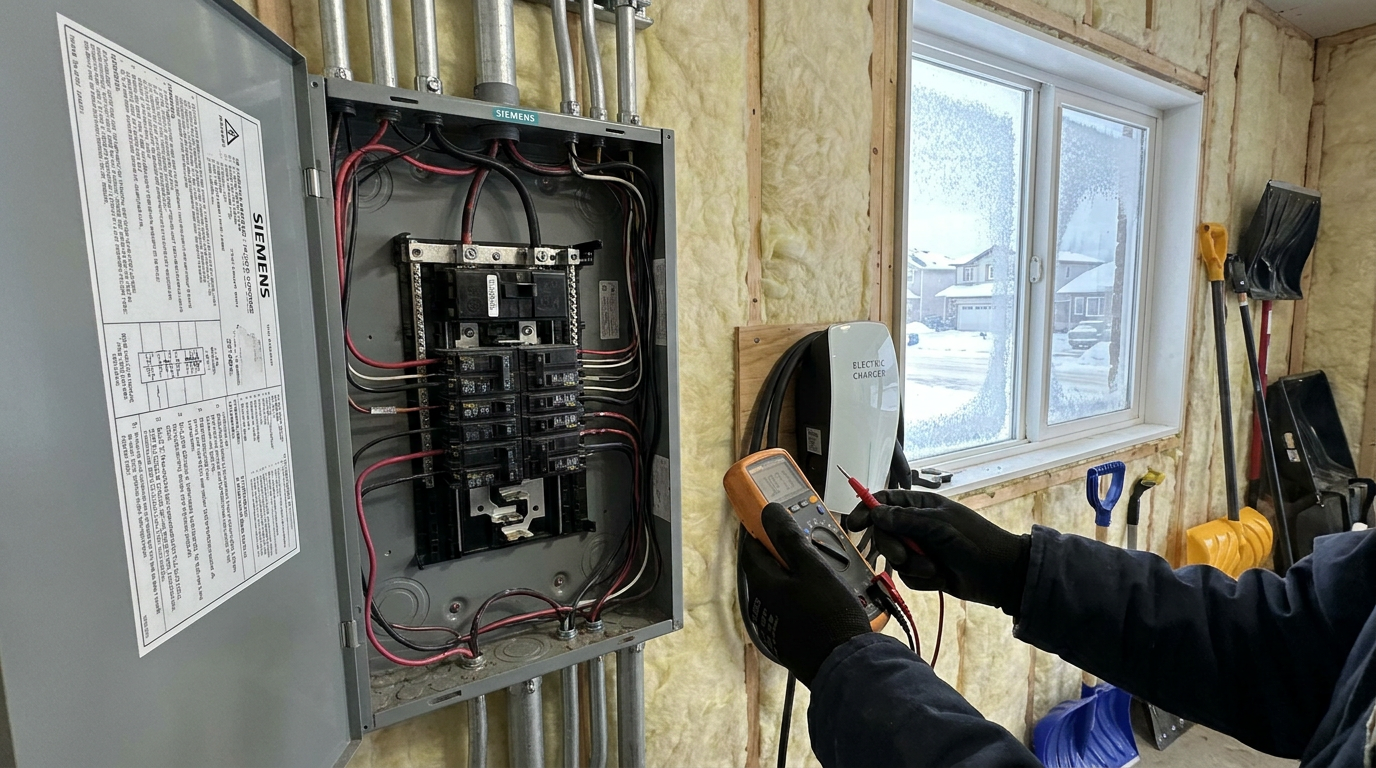
When the winter wind sweeps down across Wood Buffalo and the outdoor thermometer drops to -40°C, your home’s electrical system isn't just a matter of convenience—it is your lifeline. Hi, I am Mohammad, an Alberta Master Electrician (License #8368) with over 12 years of hands-on experience keeping homes safe and warm in Fort McMurray. From the sprawling family properties in Timberlea and the classic neighborhoods of Thickwood to the energy-efficient builds in Parsons Creek, I have worked on every type of electrical setup this region has to offer.
As electric vehicles (EVs) become more common in our northern climate, many local homeowners are reaching out to ask if their home’s electrical service is ready for a Level 2 charger. Charging a modern EV in a extreme Alberta winter presents unique technical challenges. In addition to powering your standard household appliances, your panel is already managing continuous winter loads like space heaters, heat tape, furnace blowers, and block heaters. Plopping a high-draw, continuous system like an EV charger into this mix without proper planning is a recipe for system failures.
Sizing your electrical service panel safely requires a formal residential load calculation. In this structured guide, I will take you step-by-step through how we analyze your electrical panel's capacity under the Canadian Electrical Code (CEC). Together, we will look at how extreme cold influences these variables and help you decide if it is time for a professional EV charger installation or a formal electrical service upgrade.
Why Does a -40°C Climate Impact Your Panel Load Calculation?
In mild climates, a home’s baseline energy use peaks during summer afternoon air conditioning windows. In Fort McMurray, however, our highest electrical load occurs during deep winter freezes. On a bitter January evening, the heating systems in our homes are running constantly. Let’s look at a typical lifestyle scenario: many local oil-sands shift workers return to their homes in Thickwood or Parsons Creek after a long twelve-hour shift. They immediately plug in their truck’s engine block heater, crank up the electric heaters in the workshop, and run the dishwasher. Some might even fire up a backyard spa, which requires dedicated capacity under our hot tub wiring services.
When you plug in an electric vehicle, it behaves as a continuous load. Under the rules of the Canadian Electrical Code, a continuous load is any demand that is sustained for more than three hours. Most vehicles will charge at full capacity for four to eight hours at a time, drawing maximum current the entire night. This prolonged draw places severe thermal and mechanical stress on your panel's interior components.
To keep installations safe, Rule 8-104 establishes strict boundaries for continuous loading. This code rule states that under normal conditions, the continuous load connected to a circuit must not exceed 80% of the rating of its overcurrent protection device or the maximum allowable ampacity of the conductors. For example, a standard 40-amp continuous EV load requires a dedicated 50-amp overcurrent breaker to prevent heat-related degradation. If you attempt to squeeze this onto an already-burdened 100-amp panel, you will quickly trigger issues. This is why we must first look at a comprehensive panel calculation before running any physical cables. You can run the numbers yourself with our free Fort McMurray electrical load calculator before booking a site visit.
How Do We Calculate Your Existing Electrical Load?
To determine if your home can handle a new vehicle charger, we cannot rely on guesses or the faceplate of your main breaker. We must follow a standardized calculation process designed by the Alberta Safety Codes Council and the standards laid out in the Canadian Electrical Code. This calculation looks at the total floor space of your home and adds realistic demand factors for domestic appliances.
Here is how a standard residential load calculation is structured for a single-family dwelling:
Step 1: The Basic Living Area Load
First, we calculate the primary load corresponding to the total finished living space of your home (excluding unfinished basement space). Under provincial guidance matching the Canadian Electrical Code and supported by Alberta Municipal Affairs, we assign:
- 5,000 Watts (W) for the first 90 square meters (m²) of living area.
- 1,000 W for each additional 90 m² or portion thereof.
Step 2: Large Domestic Appliances
Next, we account for standard kitchen and laundry appliances. This is calculated using standard demand factors:
- Electric Range: Added at 6,000 W (which represents the standard code demand for any residential range rated up to 12 kW).
- Electric Water Heater: If your home uses an electric tank rather than natural gas, we add the full heater nameplate rating, which is typically 3,000 W to 4,500 W.
- Electric Clothes Dryer: Treated with standard appliance demand factors, usually adding 2,500 W to 5,000 W depending on structural ratings.
Step 3: Space Heating and Air Conditioning
Our sub-zero climate demands that we look closely at winter thermal loads. First-generation or secondary baseboard heaters, central furnace blower fans, heat pumps, and heat tape are massive users of electricity. Under code rules, we calculate heating and air conditioning loads separately and apply the larger of the two to our final sum (as they will not run at the same time). In Fort McMurray, our deep heating loads always dwarf our summer cooling needs. Under code criteria, electric space heating must be calculated at its full rated wattage because of its high continuous nature in winter weather.
Step 4: Additional Continuous Demands
If you have built an outdoor oasis to survive the winter, you must account for it. Swimming pools, hot tubs, and garage heaters must be listed. If your backyard hot tub draws 40 amps at 240V, that translates to a massive 9,600 W load. We must assess these continuous equipment ratings to make sure your home does not experience extreme voltage drops, which can lead to flickering lights in your home.
Let's Run a Practical Load Calculation
To illustrate how this works, let’s run the numbers for a typical 180 m² home in Timberlea that features a natural gas furnace, an electric range, an electric dryer, and a 40A hot tub. We want to see if we can safely add a 40-amp Level 2 EV charger (9,600 W of continuous draw):
- Basic Living Space Allowance (180 m²): 6,000 W
- Electric Range Allowance: 6,000 W
- Gas Furnace Blower & general HVAC: 1,500 W
- Electric Dryer: 2,500 W (applying code demand factors)
- Backyard Hot Tub: 9,600 W
- Baseline Total Load before EV: 25,600 W
25,600 W / 240 V = 106.6 Amps.
As you can see, this home is already exceeding 100 amps of calculated service load during peak periods. If we add a Level 2 electric vehicle charger, which introduces another continuous 9,600 W (40 amps) of demand under Section 86, the new calculated load climbs to 35,200 W (146.6 Amps). Attempting to run this on a standard 100-amp electrical panel would trigger severe heat build-up, and you would likely find your main breaker keeps tripping on very cold nights.
Can Your Current 100-Amp Panel Handle a Level 2 EV Charger?
This is the most common question I receive from homeowners in older parts of our region, such as Beacon Hill and Abasand. Many of these mid-century builds were constructed with 100-amp electrical services, which was plenty of capacity before the era of multi-zone climate control, electric garage heaters, and high-voltage vehicle chargers.
As a rule of thumb, you cannot safely add a Level 2 EV charger to a standard 100-amp panel if your home also runs other heavy electrical appliances like an electric range, dryer, or hot tub. The continuous nature of charging means that if your vehicle is pulling 32 or 40 amps for six hours straight, and your electric clothes dryer or regional block heater kicks on, you will push your panel past its physical limits. For safety parameters on conductor limitations, we consult Rule 6-206, which dictates safe ampacity sizing for service panel feeds.
If you overload your service panel, you will experience clear warning signs before the main breaker trips. You may notice visual indicators, which are common when your grid is running at near-maximum limits. If you are experiencing these problems, you can read our guide on how to spot overloaded circuit signs. To avoid damaging your home electronics or causing premature failure of your appliances, you must find a safety-compliant solution. Fortunately, there are two primary methods we use to solve this issue under current Alberta code standards.
What Are the Safety Code Approved Solutions for an Overloaded Service?
If your home's calculated electrical demand exceeds your panel's safe continuous limit, you have two code-approved engineering paths forward. In my professional practice, I walk customers through the pros and cons of both options based on their immediate budget and long-term electrification plans.
Option A: The 200-Amp Service Upgrade
For most homes in Wood Buffalo, upgrading from a 100-amp service to a 200-amp service is the gold standard. Doing this involves replacing your main service conductors, your meter socket, and your interior distribution panel. This upgrade adds massive headroom to your property, allowing you to easily run an EV charger, hot tubs, workshops, and modern high-efficiency heat pumps. When performing an upgrade like this, we always install top-tier local distribution panels and breakers from leading manufacturers such as Siemens, Eaton, Square D, and Schneider Electric.
To understand the full step-by-step process of this modernization, you can read our comprehensive home electrical panel upgrade guide. Upgrading your panel resolves any thermal concerns, makes your electrical system highly resilient, and increases the long-term value of your property. For details about pricing, permitting, and timelines, feel free to visit our dedicated electrical panel upgrade services page.
Option B: Electric Vehicle Energy Management Systems (EVEMS)
If a complete service panel upgrade is outside your current budget, or if your local overhead lines make a service transition difficult, we can look at an energy management system. Recognized under Section 86 of the Canadian Electrical Code and supported by modern Alberta Electrical STANDATA publications, an EVEMS (often called a "load-shedder" or "load-miser") is an intelligent electronic controller.
The EVEMS monitors the active utility draw of your home in real time. If your household's active consumption approaches 80% of your 100-amp service capacity (during periods when the oven, dryer, and furnace are all running hard), the controller temporarily cuts power to your EV charger. Once the other household appliances complete their cycle and the main load drops, the controller restores power to your vehicle. Brands like Leviton manufacture advanced smart panels and controllers that handle this automatically. While this is an excellent, code-compliant way to bypass a full panel upgrade, there is a distinct winter catch: when overnight temps hit -40°C and your electric heaters run constantly, your EV charger might remain paused for long stretches of the night. This can be highly inconvenient for shift workers who need a fully charged battery to drive out to site locations early in the morning.
How Does Extreme Cold Impact EV Charger Installation Requirements?
The climate in Fort McMurray demands that we use materials, equipment, and installation methods built for high-stress cycles. Extreme cold causes materials to contract, copper connections to loosen, and standard residential PVC conduits to crack. When you hire an electrician to install your high-capacity charger, they must look beyond the load calculation to ensure physical safety.
Grounding, Bonding, and Frost Protection
When installing external chargers on external posts or detached garages, we pay close attention to the Rule 10-700 series. These strict code guidelines lay out the mandatory rules for bonding and grounding. Frozen soil is an incredibly poor electrical conductor. If your grounding connection is shallow or has degraded, a fault in your EV charger can energize the metal body of your car, creating a lethal shock hazard. We use professional copper rod systems driven deep below our local frost line to ensure low-impedance ground paths year-round.
Weatherproofing and Outdoor Receptacles
If your charging station is installed outdoors rather than in a heated garage, we must apply the rules of Rule 26-700 / 26-722 / 26-724. These rules dictate the safety parameters for outdoor receptacles, tamper-proof protections, and wet-location industrial covers. Any outdoor-installed EVSE must be housed in a robust, weather-sealed NEMA 4 enclosure, and we must confirm all devices wear official testing marks under Rule 2-024. We must ensure every component is tested and approved by certified bodies like CSA or Intertek (cETL) for safe operation in extreme climates. To protect your home's sensitive electronic systems from sub-zero static discharges or line surges, we also highly recommend checking out our whole-home surge protection options.
How Do You Get Started with an EV Charger Installation?
Taking on an EV charger project on your own is not safe and is illegal without the proper credentials. Sizing, bonding, and running 240-volt circuits requires deep industry training. If mistakes are made, you could void your home insurance coverage, ruin your premium vehicle's modern battery chemistry, or trigger a electrical house fire. To keep your family safe during our long winters, review our practical winter electrical safety guidelines.
Whether you live in Timberlea, Thickwood, Abasand, or any surrounding communities in Wood Buffalo, our professional team is here to help. At Crescent Electric, we travel to your property, handle the formal calculations, pull the municipal permits, and install your charger safely and cleanly.
Disclaimer: Always pull the required permit and hire a licensed electrician. This work falls under the Alberta Safety Codes Act. Engaging in major electrical installations without proper oversight is a violation of provincial law and poses extreme safety hazards to your property.
Ready to charge your vehicle safely? Visit our EV charger installation page or reach out to our team at Crescent Electric. For any urgent electrical issues, we are always here to help as your dependable emergency electrician in Fort McMurray.
About the Author
I am Mohammad, an Alberta Master Electrician (License #8368) and Red Seal certified electrical systems specialist. Over the past 12 years, I have provided professional, code-compliant, and reliable residential and commercial electrical services to homeowners throughout Fort McMurray and the regional municipality of Wood Buffalo. My team is fully licensed and carries $5,000,000 in comprehensive general liability insurance, ensuring every residential permit we pull is backed by absolute safety compliance and industry-leading workmanship.
