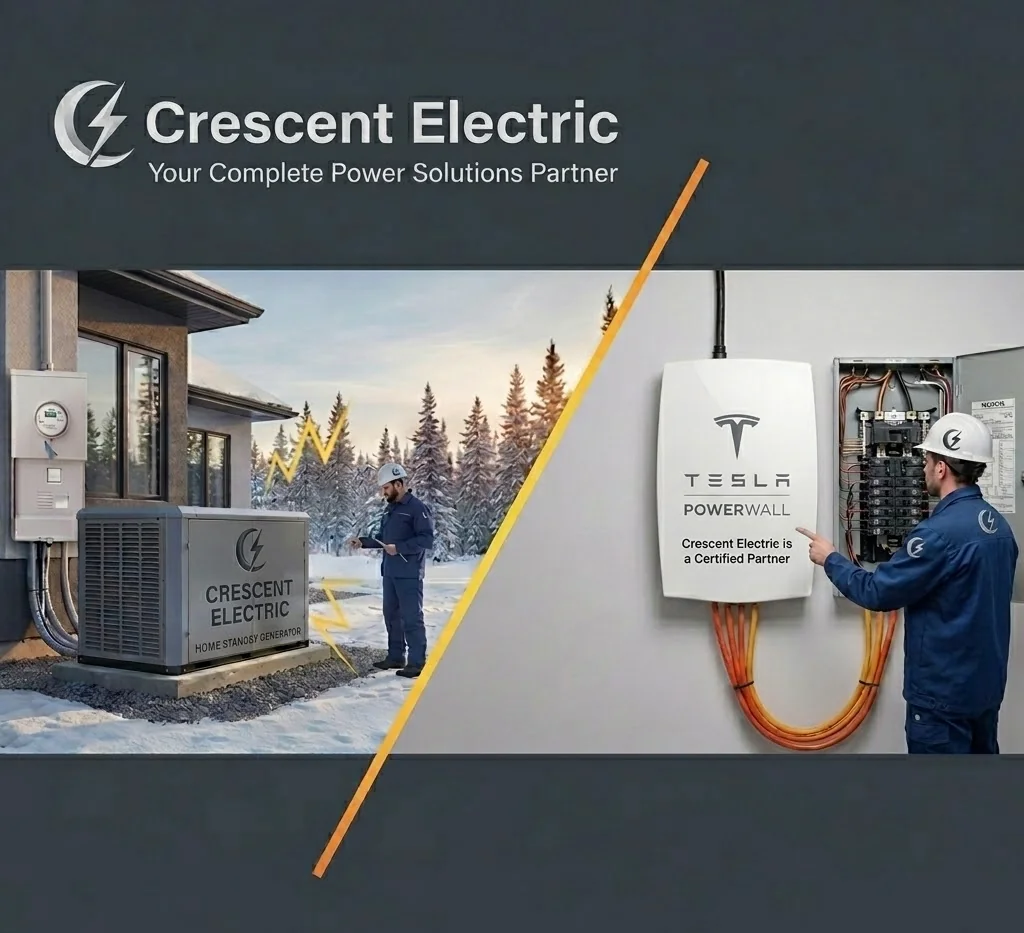
## Generator vs Battery Backup in Fort McMurray: A Master Electrician''s Cold-Climate Guide
By Mohammad — Alberta Master Electrician (License #8368), Red Seal, 12+ years of field experience. Crescent Electric, serving Wood Buffalo.
When the grid drops at -38 °C in Timberlea, you have hours — not days — before frozen pipes and a cold house turn an inconvenience into a five-figure insurance claim. This guide walks Fort McMurray homeowners through the three legitimate backup-power paths — automatic standby generators, battery storage systems, and manual transfer switches — with honest tradeoffs, real cold-weather behaviour, and the Alberta permitting steps that keep your install code-compliant and insurable.
Why Backup Power Is Different in Wood Buffalo
Fort McMurray sits in a climate zone where a 6-hour outage in January is a structural threat, not a comfort issue. A typical 2,500 sq ft home in Eagle Ridge, Parsons Creek, or Stone Creek loses furnace operation within minutes of an outage. Interior temperatures fall toward freezing within 4–8 hours at -30 °C ambient. Pipes against poorly insulated exterior walls — common in older Beacon Hill, Waterways, and Abasand builds — can begin freezing in as little as 6 hours.
For acreage owners in Saprae Creek, Anzac, and Janvier, the calculus is harder again: ATCO restoration crews prioritize population centres, and rural feeder lines can stay down for 24–72 hours after a major storm event. If you''ve already seen house-wide flickering lights or repeated breaker trips during storms, your home is also flagging that it''s under-served for the loads you''re running — backup power and a panel assessment often need to happen together.
This is why "do I need backup power?" is the wrong question in this region. The right question is: which backup system fits my home, my fuel access, and my outage-tolerance budget?
Option 1: Automatic Standby Generators
An automatic standby generator is a permanently installed engine-generator wired into your home through an Automatic Transfer Switch (ATS). The ATS monitors utility power continuously, and when an outage is detected it isolates the home from the grid and starts the generator within roughly 8–15 seconds.
Sizing for Fort McMurray Homes
The three product lines I specify most often for Wood Buffalo installs:
- Generac Guardian 22 kW – 26 kW (air-cooled) — best value for typical 2,500–4,000 sq ft homes on natural gas
- Kohler 20RESCL – 38RCL (liquid-cooled) — premium build quality, longer service intervals, quieter operation
- Cummins QuietConnect 22 kW — strong cold-start performance and good local parts availability
All three support propane for properties without natural gas service. A 500-gallon propane tank running a 22 kW unit at 50% load will last roughly 5–7 days.
The Cold-Weather Spec That Matters
> Pro Tip: Always specify the factory cold-weather kit — battery blanket, oil heater, and crankcase heater. Without it, generator starts below -30 °C are unreliable, and manufacturers commonly deny warranty claims for cold-related damage.
Pros and Cons
- Pros: Fully automatic; powers the whole home or selected critical loads; runs for days on natural gas without refueling; no homeowner action required during the outage.
- Cons: Highest upfront cost ($14,000–$28,000 installed in RMWB depending on load); requires both an electrical permit and a separate gas permit; needs annual service.
Option 2: Battery Backup Systems (Tesla Powerwall, Enphase IQ)
Battery storage has moved from a solar accessory to a mainstream backup solution. The Tesla Powerwall 3 (13.5 kWh usable) and the Enphase IQ Battery 5P (5 kWh per unit, stackable) are the two systems I install most often. If you''re already planning a Tesla Wall Connector or Level 2 EV charger install, pairing the Powerwall during the same visit shares trenching, conduit, and inspection costs.
Where Batteries Win
- Instantaneous transfer — no engine-start delay; sensitive electronics never reboot
- Silent operation — ideal for tight Timberlea cul-de-sacs with zero-lot-line setbacks where a generator''s noise would be a neighbour problem
- No fuel logistics — no propane tank, no gasoline stabilizer, no jerry cans in the garage
- Solar integration — pairs cleanly with a 7–12 kW rooftop array for partial off-grid capability
- Time-of-use savings — charge from the grid during off-peak rates, discharge during peak
- Smart home integration — monitor backup loads, automate priority circuits, and tie batteries into a broader smart home and automation setup right from your phone
Where Batteries Lose
The honest tradeoff in Fort McMurray is runtime during a sustained outage. A single Powerwall 3 will run a furnace, fridge, and basic lighting for roughly 18–24 hours. A multi-day January outage requires either multiple stacked batteries (up to four units) or a hybrid system — battery for instantaneous transfer plus a generator for long-duration runtime.
Battery performance also degrades meaningfully in cold ambient temperatures. Outdoor installs in Fort McMurray require either an insulated, heated enclosure or — better — interior placement in a heated mechanical room or garage.
Option 3: Manual Transfer Switch With a Portable Generator
For homeowners who aren''t ready for a $20,000+ standby system, a professionally installed Manual Transfer Switch (MTS) with a weatherproof inlet box is the single best investment I recommend. A typical system includes:
- A 6, 8, or 10-circuit transfer switch mounted next to the main panel
- A 30 A or 50 A weatherproof inlet box mounted on a sheltered exterior wall
- Pre-wired connections to your most critical loads (furnace, fridge, well pump, key lighting, garage door)
- A portable inverter generator (Honda EU7000iS, Champion 7500W) connected via a heavy-gauge L14-30 cord
Why the MTS Matters for Safety
The single largest safety benefit of an MTS is that it makes back-feeding the panel physically impossible. Plugging a portable generator into a dryer outlet, or running extension cords through a window, are both extremely common DIY practices — and both can electrocute a utility lineman working to restore power, plus destroy the generator when grid power returns. An MTS is the only legal, insurance-compliant way to use a portable generator with your home''s wiring. If you''re unsure what shape your existing panel and branch wiring are in — especially if you have aluminum wiring — book an electrical inspection before adding any transfer hardware.
> Pro Tip — Inlet Placement: Mount the inlet box on a sheltered wall under a soffit overhang, not on an exposed face. Snow and ice buildup on an unsheltered inlet at -30 °C makes the cord almost impossible to seat properly with cold-stiffened gloves.
Permits, Inspections, and Code Compliance
Every backup-power installation in the Regional Municipality of Wood Buffalo requires:
- An electrical permit issued under the Alberta Safety Codes Act for the transfer switch and any new branch circuits
- A gas permit — separately issued — for natural gas or propane fuel piping to standby generators
- Compliance with the Canadian Electrical Code (CSA C22.1) including the grounding and bonding rules in the CEC 10-700 series for the generator frame and the transfer switch
- Compliance with provincial safety regulations for utility-interconnection (your installer handles the technical citation; do not attempt this without a Master Electrician of record)
- Manufacturer-required clearances — typically 18" from any window, door, or fresh-air intake
- Annual maintenance: oil change, filter replacement, full load-bank test, transfer-switch exercise
Crescent Electric coordinates the electrical permit, gas permit, and final RMWB inspection in a single project — homeowners receive a turnkey installation with documented compliance for both insurance underwriting and resale.
Quick Comparison Table
- Whole-home automatic backup, multi-day outages, set-and-forget: Standby generator
- Silent, instant transfer, frequent short outages, solar integration: Battery system
- Tight budget, willing to start a portable generator manually: MTS + portable inverter
- Worst-case January scenario at an acreage: Hybrid — battery for instant transfer plus a propane standby generator for runtime
Safe Practices During Any Outage
- Unplug sensitive electronics before power is restored to avoid surge damage
- Keep refrigerator and freezer doors closed — a full freezer holds for up to 48 hours
- Never operate a portable generator indoors or in an attached garage — carbon monoxide is colourless, odourless, and lethal
- Treat all downed wires as live — stay back and call ATCO Electric and 911
- Conserve phone battery — switch to low-power mode and limit screen-on time
If power is restored and something doesn''t look right — burning smell, scorched outlet, breaker that won''t reset — call our 24/7 emergency electrician line before re-energizing the affected circuit.
Frequently Asked Questions
How big a generator do I need for an average Fort McMurray home?
A 2,500–4,000 sq ft home on natural gas with a typical electric range, furnace, fridge, well pump or sump pump, and standard lighting loads is well served by a 22–26 kW air-cooled standby generator. Larger homes, homes with electric heat strips, or homes with hot tubs and EV chargers may need a liquid-cooled unit in the 36–48 kW range. A formal load calculation per the Canadian Electrical Code is the only correct way to size — not square footage alone. If your existing service is undersized, a 200 A panel upgrade usually has to happen first.
Will a Tesla Powerwall actually work through a Fort McMurray winter outage?
Yes, with two caveats. First, a single Powerwall 3 delivers roughly 18–24 hours of backup for a typical critical-loads configuration (furnace, fridge, lighting) — enough for most local outages but not for a multi-day event. Second, the battery itself must be installed in a heated space (mechanical room, garage, or insulated enclosure) so it doesn''t lose capacity in extreme cold. For homeowners who want both instant transfer and multi-day runtime, a hybrid Powerwall + standby generator is the right answer.
Can I install a generator or battery system myself to save money?
No — and this is one area where the financial risk of DIY dwarfs the savings. Backup-power installations require an electrical permit issued to a licensed contractor under the Alberta Safety Codes Act, plus a separate gas permit for fuel piping. An unpermitted install will be flagged on home sale, may void your home insurance after a fire or equipment failure, and — in the case of an unprotected back-feed — exposes you to civil liability if a utility lineman is injured. Every legitimate Fort McMurray backup install is permitted, inspected, and signed off by a Master Electrician of record.
Safety Disclaimer
This article is educational and reflects general best practices for the Fort McMurray climate and the Canadian Electrical Code as enforced in Alberta. It is not a substitute for a site-specific assessment by a licensed electrician. Backup-power installations involve interconnection with the utility grid, fuel systems, and combustion equipment — all of which carry serious safety, code, and insurance implications. Always engage a licensed Alberta electrical contractor and obtain the required permits from your local Safety Codes Officer before any work begins.
About the Author
Mohammad is an Alberta Master Electrician (License #8368) and Red Seal Certified journeyman with over 12 years of specialized field experience spanning residential infrastructure, commercial retail systems, and heavy industrial oil-sands projects across Northern Alberta. As the Master Electrician of record at Crescent Electric, he has designed and installed standby generators, battery storage systems, and transfer-switch solutions for homes throughout Timberlea, Thickwood, Eagle Ridge, Parsons Creek, Beacon Hill, Abasand, Waterways, and the rural acreages of Saprae Creek and Anzac. Crescent Electric is fully licensed, bonded, and insured under the Alberta Safety Codes Act.
Ready to make your home outage-proof? Contact Mohammad directly at (587) 557-5494 or book your code-compliant backup-power assessment online today.
